
|
You entered: dust lanes
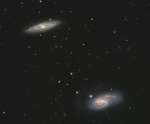 M65 and M66
15.06.2012
Nearby and bright, spiral galaxies M65 (top) and M66 stand out in this engaging cosmic snapshot. The pair are just 35 million light-years distant and around 100,000 light-years across, about the size of our own spiral Milky Way.
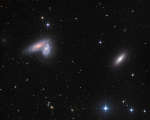 Twin Galaxies in Virgo
1.02.2019
Spiral galaxy pair NGC 4567 and NGC 4568 share this sharp cosmic vista with lonely elliptical galaxy NGC 4564. All are members of the large Virgo Galaxy Cluster. With their classic spiral arms, dust lanes, and star clusters, the eye-catching spiral pair is also known as the Butterfly Galaxies or the Siamese Twins.
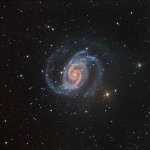 NGC 1566: The Spanish Dancer Spiral Galaxy
14.01.2022
An island universe of billions of stars, NGC 1566 lies about 60 million light-years away in the southern constellation Dorado. Popularly known as the Spanish Dancer galaxy, it's seen face-on from our Milky Way perspective.
 Stars, Gas, and Dust Battle in the Carina Nebula
15.08.2017
Chaos reigns in the Carina Nebula where massive stars form and die. Striking and detailed, this close-up of a portion of the famous nebula is a combination of light emitted by hydrogen (shown in red) and oxygen (shown in blue).
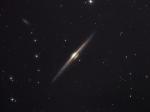 NGC 4565: Galaxy on the Edge
8.07.2005
Magnificent spiral galaxy NGC 4565 is viewed edge-on from planet Earth. Also known as the Needle Galaxy for its narrow profile, bright NGC 4565 is a stop on many telescopic tours of the northern sky as it lies in the faint but well-groomed constellation Coma Berenices.
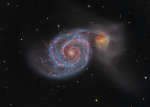 M51: The Whirlpool Galaxy
2.05.2015
Follow the handle of the Big Dipper away from the dipper's bowl until you get to the handle's last bright star. Then, just slide your telescope a little south and west and you might find this stunning pair of interacting galaxies, the 51st entry in Charles Messier famous catalog.
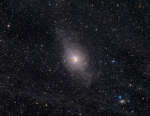 Centaurus A
9.03.2017
Only 11 million light-years away, Centaurus A is the closest active galaxy to planet Earth. Spanning over 60,000 light-years, the peculiar elliptical galaxy also known as NGC 5128, is featured in this sharp telescopic view.
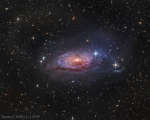 Messier 63: The Sunflower Galaxy
6.06.2019
A bright spiral galaxy of the northern sky, Messier 63 is about 25 million light-years distant in the loyal constellation Canes Venatici. Also cataloged as NGC 5055, the majestic island universe is nearly 100,000 light-years across. That's about the size of our own Milky Way Galaxy.
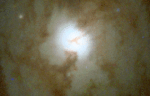 In the Center of the Whirlpool
25.04.1996
In the center of M51, a spiral galaxy 23 million light-years away, astronomers have identified a dense region of young stars. The graceful swirling arcs of this galaxy's spiral arms have inspired its popular name, "The Whirlpool Galaxy".
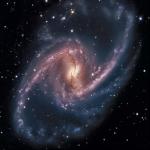 NGC 1365: Majestic Island Universe
28.03.2007
Barred spiral galaxy NGC 1365 is truly a majestic island universe some 200,000 light-years across. Located a mere 60 million light-years away toward the chemical constellation Fornax, NGC 1365 is a dominant member of the well-studied Fornax galaxy cluster.
|
January February March April May June July August |
||||||||||||||||||||||||||||||||||||||||||||||||||||||||