
|
You entered: apollo
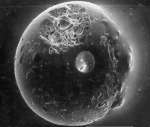 A Spherule from the Earths Moon
10.01.2010
How did this spherule come to be on the Moon? When a meteorite strikes the Moon, the energy of the impact melts some of the splattering rock, a fraction of which might cool into tiny glass beads. Many of these glass beads were present in lunar soil samples returned to Earth by the Apollo missions.
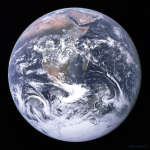 Blue Marble Earth
6.02.2022
Welcome to planet Earth, the third planet from a star named the Sun. The Earth is shaped like a sphere and composed mostly of rock. Over 70 percent of the Earth's surface is water. The planet has a relatively thin atmosphere composed mostly of nitrogen and oxygen.
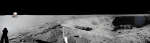 Tranquility Base Panorama
19.07.2019
On July 20, 1969 the Apollo 11 lunar module Eagle safely touched down on the Moon. It landed near the southwestern corner of the Moon's Mare Tranquillitatis at a landing site dubbed Tranquility Base. This panoramic view of Tranquility Base was constructed from the historic photos taken from the lunar surface.
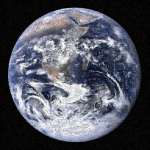 Mosaic: Welcome to Planet Earth
13.07.2010
Welcome to Planet Earth, the third planet from a star named the Sun. The Earth is shaped like a sphere and composed mostly of rock. Over 70 percent of the Earth's surface is water. The planet has a relatively thin atmosphere composed mostly of nitrogen and oxygen.
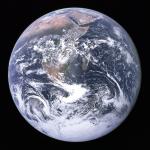 Welcome to Planet Earth
25.03.2007
Welcome to Planet Earth, the third planet from a star named the Sun. The Earth is shaped like a sphere and composed mostly of rock. Over 70 percent of the Earth's surface is water. The planet has a relatively thin atmosphere composed mostly of nitrogen and oxygen.
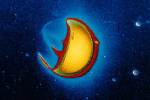 Ultraviolet Earth
10.06.1996
Here's a switch: the above picture is of the Earth taken from a lunar observatory! This false color picture shows how the Earth glows in ultraviolet (UV) light. UV light is so blue humans can't see it.
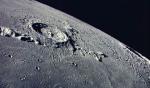 Bats And The Barren Moon
31.10.1998
This picture, taken as the Apollo 17 astronauts orbited the Moon in 1972, depicts the stark lunar surface around the Eratosthenes and Copernicus craters. Images of a Moon devoid of life are familiar to denizens of the space age.
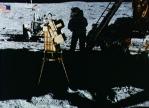 The First Lunar Observatory
11.11.2000
The first, and so far only, lunar astronomical observatory was deployed by the Apollo 16 crew in 1972. The Far Ultraviolet Camera / Spectrograph used a 3-inch diameter Schmidt telescope to photograph the Earth, nebulae, star clusters, and the Large Magellanic Cloud.
 Odysseus and The Dish
1.03.2024
Murriyang, the CSIROБs Parkes radio telescope points toward a nearly Full Moon in this image from New South Wales, Australia, planet Earth. Bathed in moonlight, the 64 meter dish is receiving weak radio signals from Odysseus, following the robotic lander's February 22 touch down some 300 kilometers north of the Moon's south pole.
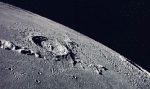 The Barren Moon
31.10.1996
The above photo, taken as the Apollo 17 astronauts orbited the Moon in 1972, depicts the stark lunar surface around the Eratosthenes and Copernicus craters. Many similar images of a Moon devoid of life are familiar to denizens of the space age.
|
January February March April May June July August September |
|||||||||||||||||||||||||||||||||||||||||||||||||