
|
You entered: star
 The Tarantula Zone
7.03.2024
The Tarantula Nebula, also known as 30 Doradus, is more than a thousand light-years in diameter, a giant star forming region within nearby satellite galaxy the Large Magellanic Cloud. About 180 thousand light-years away, it's the largest, most violent star forming region known in the whole Local Group of galaxies.
 A Close Encounter of the Stellar Kind
26.06.1997
The unassuming star centered in this sky view will one day be our next door stellar neighbor. The faint 9th magnitude red dwarf currently 63 light-years away in the constellation Ophiucus was recently discovered to be on a course toward our Solar System.
 NGC 6188 and NGC 6164
28.07.2011
Fantastic shapes lurk in clouds of glowing hydrogen gas in NGC 6188. The emission nebula is found near the edge of a large molecular cloud, unseen at visible wavelengths, in the southern constellation Ara, about 4,000 light-years away.
 In the Arms of M83
11.11.2011
Big, bright, and beautiful, spiral galaxy M83 lies a mere twelve million light-years away, near the southeastern tip of the very long constellation Hydra. This cosmic close-up, a mosaic based on data from...
 VDB 142 in Cepheus
11.10.2001
A gorgeous collection of dust and gas nebulae in the Northern Milky Way graces the high and far off constellation of Cepheus. With colors based on astronomical filters, this close up of the region highlights stars embedded in curiously shaped cosmic clouds.
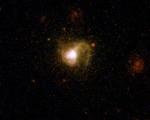 POX 186: Not So Long Ago
27.02.2004
Not so long ago and not so far, far away, a galaxy was born. Seen in this Hubble Space Telescope image, the island universe of stars, gas, and dust cataloged as POX 186 is a mere 68 million light-years distant toward an uncrowded region in the constellation Virgo.
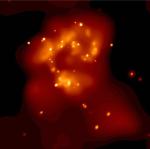 X-Rays From Antennae Galaxies
18.08.2000
A bevy of black holes and neutron stars shine as bright, point-like sources against bubbles of million degree gas in this false-color x-ray image from the orbiting Chandra Observatory. The striking picture shows...
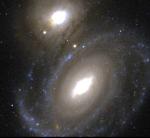 Galaxies Away
21.08.1999
This striking pair of galaxies is far, far away ... about 350 million light-years from Earth. Cataloged as AM0500-620, the pair is located in the southern constellation Dorado. The background elliptical and foreground spiral galaxy are representative of two of the three major classes of galaxies which inhabit our Universe.
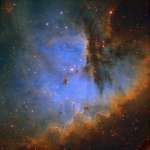 NGC 281
9.12.2008
Look through the cosmic cloud cataloged as NGC 281 and it's almost easy to miss stars of the open cluster IC 1590. But, formed within the nebula, that cluster's young, massive stars ultimately power the pervasive nebular glow.
 Gemini Observatory North
14.10.2016
It does look like a flying saucer, but this technologically advanced structure is not here to deliver the wise extraterrestrial from the scifi classic movie The Day the Earth Stood Still. It is here to advance our knowledge of the Universe though.
|
January February March April May June July August September |
|||||||||||||||||||||||||||||||||||||||||||||||||