
|
You entered: NASA
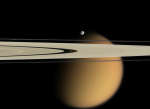 Titan Beyond the Rings
1.11.2014
When orbiting Saturn, be sure to watch for breathtaking superpositions of moons and rings. One such picturesque vista was visible recently to the robot Cassini spacecraft now orbiting Saturn. In 2006 April, Cassini captured Saturn's A and F rings stretching in front of cloud-shrouded Titan.
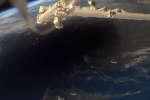 Earth During a Total Eclipse of the Sun
17.03.2015
What does the Earth look like during a total solar eclipse? It appears dark in the region where people see the eclipse, because that's where the shadow of the Moon falls. The shadow...
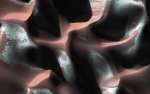 Martian Chiaroscuro
13.04.2018
Deep shadows create dramatic contrasts between light and dark in this high-resolution close-up of the martian surface. Recorded on January 24, 2014 by the HiRISE camera onboard the Mars Reconnaissance Orbiter, the scene spans about 1.5 kilometers.
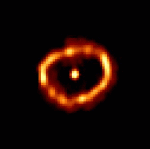 Nova Cygni 1992
26.12.1995
In 1992 a tremendous explosion occurred in the constellation of Cygnus. Dubbed Nova Cygni 1992, this event most probably occurred in an accretion disk binary system. Astronomers hypothesize that this system's white dwarf had so much gas dumped onto it's surface that conditions became ripe for nuclear fusion.
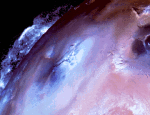 Erupting Volcanoes on Io
5.08.1996
Jupiter's moon Io has active volcanoes. The Voyager spacecraft caught several erupting when they passed the energetic moon in 1979. In the above picture, several of Io's volcanoes are visible and one is seen actually erupting.
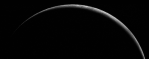 A Crescent Earth At Midnight
6.10.1996
The Earth's northern hemisphere appears outlined as a sunlit crescent in this dramatic view from the GOES 8 satellite. The image was made near midnight for the Geostationary Operational Environmental Satellite on June 22 this year, two days after the Summer Solstice.
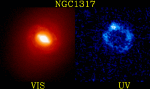 Starburst Ring in Galaxy NGC 1317
10.12.1996
Where do stars form? A typical place is an area of dense nebular gas common to arms in spiral galaxies. Sometimes, however, a burst of star formation can occur with unusual geometry. Nearby galaxy NGC 1317 shows such an unusual ring of star formation surrounding its barred nucleus.
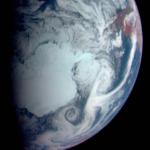 A Passing Spaceship Views Earth
3.02.1998
This is how Earth appeared to the passing spacecraft NEAR. The Near Earth Asteroid Rendezvous (NEAR) spacecraft was launched from Florida, USA, planet Earth in 1996. After a quick flyby of asteroid Mathilde in June last year, NEAR passed the Earth two weeks ago on its way to asteroid 433 Eros.
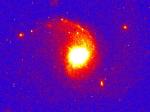 Quasar in an Elliptical Galaxy
9.04.1998
Where do quasars live? Quasars are the brightest objects in the universe, so bright they can be seen from across the universe. Observations continue to show that most quasars are surrounded by a relatively faint nebulous patch. Astronomers are trying to identify the nature of these patches.
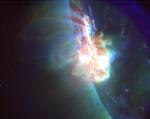 An Active Region of the Sun
16.06.1998
The Sun is a busy place. This false-color image depicts an active region near an edge of the Sun. Hot plasma is seen exploding off the Sun's photosphere and traveling along loops defined by the Sun's magnetic field.
|
January February |
|||||||||||||||||||||||||||||||||||||||||||||||||