
|
You entered: constellation
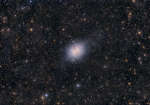 Peculiar Elliptical Galaxy Centaurus A
30.06.2014
What's happened to the center of this galaxy? Unusual and dramatic dust lanes run across the center of elliptical galaxy Centaurus A. These dust lanes are so thick they almost completely obscure the galaxy's center in visible light.
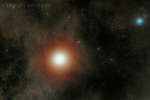 The Day After Mars
31.10.2014
October 31, 1938 was the day after Martians encountered planet Earth, and everything was calm. Reports of the invasion were revealed to be part of a Halloween radio drama, the now famous broadcast based on H.G. Wells' scifi novel War of the Worlds.
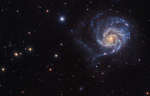 A View Toward M101
19.05.2017
Big, beautiful spiral galaxy M101 is one of the last entries in Charles Messier's famous catalog, but definitely not one of the least. About 170,000 light-years across, this galaxy is enormous, almost twice the size of our own Milky Way galaxy.
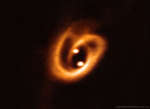 BHB2007: A Baby Binary Star in Formation
15.10.2019
How do binary stars form? To help find out, ESO's Atacama Large Millimeter Array (ALMA) recently captured one of the highest resolution images yet taken of a binary star system in formation. Most...
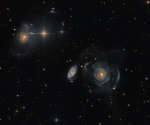 Shell Galaxies in Pisces
26.08.2020
This intergalactic skyscape features a peculiar system of galaxies cataloged as Arp 227 some 100 million light-years distant. Swimming within the boundaries of the constellation Pisces, Arp 227 consists of the two galaxies prominent right of center, the curious shell galaxy NGC 474 and its blue, spiral-armed neighbor NGC 470.
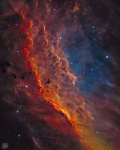 NGC 1499: The California Nebula
9.03.2021
Could Queen Calafia's mythical island exist in space? Perhaps not, but by chance the outline of this molecular space cloud echoes the outline of the state of California, USA. Our Sun has its home within the Milky Way's Orion Arm, only about 1,000 light-years from the California Nebula.
 M15: Dense Globular Star Cluster
14.06.2023
Messier 15 is an immense swarm of over 100,000 stars. A 13 billion year old relic of the early formative years of our galaxy it's one of about 170 globular star clusters that still roam the halo of the Milky Way.
 Planetary Nebula Abell 7
6.03.2025
Very faint planetary nebula Abell 7 is about 1,800 light-years distant. It lies just south of Orion in planet Earth's skies toward the constellation Lepus, The Hare. Surrounded by Milky Way stars...
 APOD: 2025 June 2 Б Veil Nebula: Wisps of an Ancient Supernova
1.06.2025
Wisps like this are all that remain visible of a Milky Way star. About 7,000 years ago that star exploded in a supernova, leaving the Veil Nebula. At the time, the expanding cloud was likely as bright as a crescent Moon, remaining visible for weeks to people living at the dawn of recorded history.
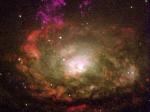 The Circinus Galaxy
3.12.2000
Powerful forces are at play in the nearby Circinus Galaxy. Hot gas, colored pink, is being ejected out of the spiral galaxy from the central region. Much of Circinus' tumultuous gas, however, is concentrated in two rings.
|
January February |
|||||||||||||||||||||||||||||||||||||||||||||||||