
|
You entered: nearest stars
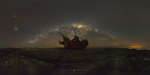 Milky Way over Shipwreck
30.11.2016
What happened to this ship? It was carried aground by a giant storm that struck the coast of Argentina in 2002. The pictured abandoned boat, dubbed Naufragio del Chubasco, wrecked near the nearly abandoned town of Cabo Raso (population: 1). The rusting ship provides a picturesque but perhaps creepy foreground for the beautiful sky above.
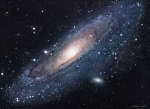 M31: The Andromeda Galaxy
17.12.2018
What is the nearest major galaxy to our own Milky Way Galaxy? Andromeda. In fact, our Galaxy is thought to look much like Andromeda. Together these two galaxies dominate the Local Group of galaxies. The diffuse light from Andromeda is caused by the hundreds of billions of stars that compose it.
 M31: The Andromeda Galaxy
27.12.2016
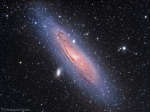
What is the nearest major galaxy to our own Milky Way Galaxy? Andromeda. In fact, our Galaxy is thought to look much like Andromeda. Together these two galaxies dominate the Local Group of galaxies. The diffuse light from Andromeda is caused by the hundreds of billions of stars that compose it.
 M31: The Andromeda Galaxy
30.08.2015
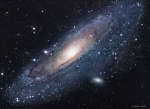
What is the nearest major galaxy to our own Milky Way Galaxy? Andromeda. In fact, our Galaxy is thought to look much like Andromeda. Together these two galaxies dominate the Local Group of galaxies. The diffuse light from Andromeda is caused by the hundreds of billions of stars that compose it.
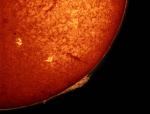 Orange Sun Simmering
29.07.2003
Even a quiet Sun is a busy place. The above image, taken in a single color of light called Hydrogen Alpha, records a great amount of detail of the simmering surface of our parent star.
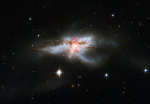 NGC 6240: Merging Galaxies
21.05.2015
NGC 6240 offers a rare, nearby glimpse of a cosmic catastrophe in its final throes. The titanic galaxy-galaxy collision takes place a mere 400 million light-years away in the constellation Ophiuchus. The merging galaxies spew distorted tidal tails of stars, gas, and dust and undergo fast and furious bursts of star formation.
 Comet ISON Before and After
29.11.2013
Sungrazing Comet ISON reached perihelion, its closest approach to the Sun, yesterday, November 28, at 18:45 UT. The comet passed just over 1 million kilometers above the solar surface, a distance less than the diameter of the Sun.
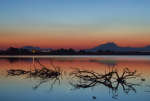 Four Planet Sunset
13.06.2013
You can see four planets in this serene sunset image, created from a series of stacked digital exposures captured near dusk on May 25. The composite picture follows the trail of three of them...
 APOD: 2025 September 26 Б A SWAN an ATLAS and Mars
26.09.2025
A new visitor to the inner Solar System, comet C/2025 R2 (SWAN) sports a long ion tail extending diagonally across this almost 7 degree wide telescopic field of view recorded on September 21.
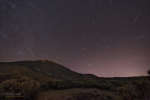 Quadrantids
9.01.2019
Named for a forgotten constellation, the Quadrantid Meteor Shower is an annual event for planet Earth's northern hemisphere skygazers It usually peaks briefly in the cold, early morning hours of January 4. The shower's radiant on the sky lies within the old, astronomically obsolete constellation Quadrans Muralis.
|
January February March April May June July August September October |
|||||||||||||||||||||||||||||||||||||||||||||||||