
|
You entered: nearest stars
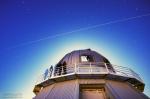 ISS Over Mont Megantic Observatory
18.08.2007
On August 1st, a time exposure created this surreal view that looks up into the early morning sky over southern Quebec. Only the light from a nearly Full Moon brightens the sky and highlights the dome of the 1.6 meter telescope at Mont-Megantic Observatory.
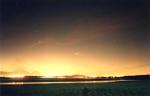 Hale-Bopp: Climbing Into Southern Skies
15.05.1997
Fighting the glow of the setting sun and the city lights of Cape Town, South Africa, comet Hale-Bopp is just visible near the center of this panoramic view - photographed on May 3rd.
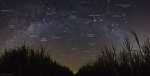 A Starry Night in Brazil
9.05.2009
This panoramic image tracing constellations in the southern sky shows off a beautiful vista toward the center of our Milky Way Galaxy. It was recorded just last month near the city of Campos in northeastern Rio de Janeiro state, Brazil.
 Nova over Thailand
21.11.2016
A nova in Sagittarius is bright enough to see with binoculars. Detected last month, the stellar explosion even approached the limit of naked-eye visibility last week. A classical nova results from a thermonuclear explosion...
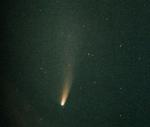 Comet NEAT in Southern Skies
6.03.2003
After last month's dramatic swoop past the Sun, Comet NEAT (C/2002 V1) appeared as a naked-eye comet, emerging from the evening twilight in planet Earth's southern skies. On March 1st, New Zealand...
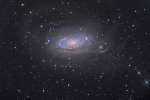 Messier 63: The Sunflower Galaxy
17.04.2008
A bright spiral galaxy of the northern sky, Messier 63 is about 25 million light-years distant in the loyal constellation Canes Venatici. Also cataloged as NGC 5055, the majestic island universe is nearly 100,000 light-years across, about the size of our own Milky Way.
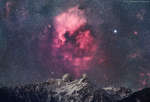 North American Nightscape
29.01.2021
On January 21, light from the Moon near first quarter illuminated the foreground in this snowy mountain and night scene. Known as The Lions, the striking pair of mountain peaks are north of Vancouver, British Colombia, Canada, North America, planet Earth.
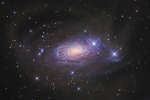 Star Streams and the Sunflower Galaxy
11.09.2010
A bright spiral galaxy of the northern sky, Messier 63 is about 25 million light-years distant in the loyal constellation Canes Venatici. Also cataloged as NGC 5055, the majestic island universe is nearly 100,000 light-years across, about the size of our own Milky Way.
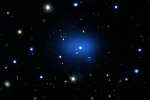 JKCS041: The Farthest Galaxy Cluster Yet Measured
28.10.2009
What if we could see back to the beginning of the universe? We can -- since it takes the age of the universe for light to cross the universe. Peering at distant objects, therefore, tells us about how the universe used to be, even near its beginning.
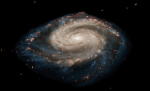 Virtual Flyby of the Whirlpool Galaxy
6.05.2019
What would it look like to fly over a spiral galaxy? To help visualize this, astronomers and animators at the Space Telescope Science Institute computed a virtual flyby of the Whirlpool Galaxy (M51) using data and images from the Hubble Space Telescope.
|
January February March April May June July August September October |
|||||||||||||||||||||||||||||||||||||||||||||||||