
|
You entered: stars
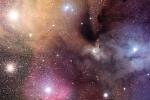 The Colorful Clouds of Rho Ophiuchi
3.09.2007
The many spectacular colors of the Rho Ophiuchi (oh'-fee-yu-kee) clouds highlight the many processes that occur there. The blue regions shine primarily by reflected light. Blue light from the star Rho Ophiuchi and nearby stars reflects more efficiently off this portion of the nebula than red light.
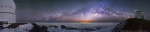 Mauna Kea Milky Way Panorama
19.02.2009
Aloha and welcome to a breathtaking skyscape. The dreamlike panoramic view looks out from the 4,200 meter volcanic summit of Mauna Kea, Hawai'i, across a layer of clouds toward a starry night sky and the rising Milky Way.
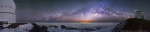 Milky Way Panorama from Mauna Kea
10.03.2013
Aloha and welcome to a breathtaking skyscape. The dreamlike panoramic view looks out from the 4,200 meter volcanic summit of Mauna Kea, Hawai'i, across a layer of clouds toward a starry night sky and the rising Milky Way.
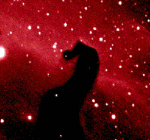 A Close-Up of the Horsehead Nebula
5.10.1996
1500 light years away lies a nebula of quite peculiar shape. How did the dark dust cloud shown above come to be shaped like a horse's head? Nobody knows! Barnard 33, as this...
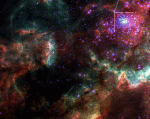 In the Center of 30 Doradus
21.02.1999
In the center of 30 Doradus lies a huge cluster of the largest, hottest, most massive stars known. The center of this cluster, known as R136, is boxed in the upper right portion of the above picture.
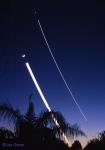 Venus Falls Out of the Evening Sky
3.09.1999
Orbiting closer to the Sun than planet Earth, bright Venus always appears to be near the Sun's position in our sky and often shines near the horizon in twilight hours. In fact, after...
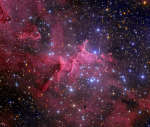 Melotte 15 in the Heart
27.12.2013
Cosmic clouds seem to form fantastic shapes in the central regions of emission nebula IC 1805. Of course, the clouds are sculpted by stellar winds and radiation from massive hot stars in the nebula's newborn star cluster, Melotte 15.
 M100: A Grand Design Spiral Galaxy
25.12.2018
Majestic on a truly cosmic scale, M100 is appropriately known as a grand design spiral galaxy. It is a large galaxy of over 100 billion stars with well-defined spiral arms that is similar to our own Milky Way Galaxy.
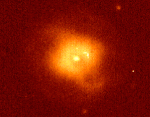 NGC 4361: Galaxy Shaped Planetary Nebula
29.12.1995
Glowing in the red light emitted by hydrogen atoms, the planetary nebula NGC 4361 is pictured above. The nebula itself is formed by the outer layers of gas shrugged off by the central star visible in the image.
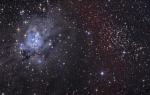 NGC 7129 and NGC 7142
13.09.2007
This alluring telescopic image looks toward the constellation Cepheus and an intriguing visual pairing of dusty reflection nebula NGC 7129 (left) and open star cluster NGC 7142. The two appear separated by only half a degree on the sky, but they actually lie at quite different distances.
|
January February March April May June July August September October |
|||||||||||||||||||||||||||||||||||||||||||||||||