
|
You entered: Earth
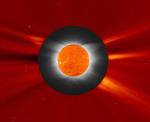 Solar Eclipse and SOHO
31.03.2006
Neither rain, nor snow, nor dark of night can keep the space-based SOlar Heliospheric Observatory (SOHO) from watching the Sun. In fact, from its vantage point 150 million kilometers sunward of planet Earth, SOHO's cameras can always monitor the Sun's outer atmosphere, or corona.
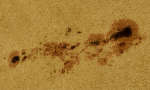 Large Sunspots Now Crossing the Sun
10.07.2013
One of the largest sunspot regions in recent years is now crossing the Sun. This region of convoluted magnetic fields may well produce a solar flare that releases a cloud of energetic particles into the Solar System.
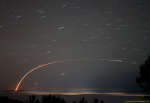 OCO 2 Night Launch
4.07.2014
In this alluring time exposure, star trails arc across the night sky above foggy Monterey Bay and the lights of Santa Cruz, California in the United States of America. Since the exposure began around...
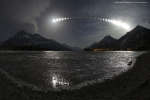 Total Lunar Eclipse over Waterton Lake
27.09.2015
Recorded in 2014 April, this total lunar eclipse sequence looks south down icy Waterton Lake from the Waterton Lakes National Park in Alberta, Canada, planet Earth. The most distant horizon includes peaks in Glacier National Park, USA.
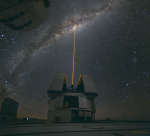 A Laser Strike at the Galactic Center
5.01.2019
Why are these people shooting a powerful laser into the center of our Galaxy? Fortunately, this is not meant to be the first step in a Galactic war. Rather, astronomers at the Very Large Telescope (VLT) site in Chile are trying to measure the distortions of Earth's ever changing atmosphere.
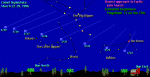 Where to See Comet Hyakutake
21.03.1996
People the world over are preparing to witness the closest approach of the brightest comet of the past twenty years. Comet Hyakutake, discovered just two months ago, will pass nearest the Earth Monday morning. All during the coming week, Comet Hyakutake will be visible in the northern sky as an unusual extended fuzzy patch.
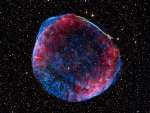 SN 1006 Supernova Remnant
12.07.2014
A new star, likely the brightest supernova in recorded human history, lit up planet Earth's sky in the year 1006 AD. The expanding debris cloud from the stellar explosion, found in the southerly constellation of Lupus, still puts on a cosmic light show across the electromagnetic spectrum.
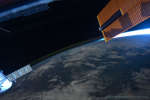 A Perseid Below
7.08.2021
Earthlings typically watch meteor showers by looking up. But this remarkable view, captured on August 13, 2011 by astronaut Ron Garan, caught a Perseid meteor by looking down. From Garan's perspective onboard...
 Earthset from Orion
19.11.2024
Eight billion people are about to disappear in this snapshot from space taken on 2022 November 21. On the sixth day of the Artemis I mission, their home world is setting behind the Moon's bright edge as viewed by an external camera on the outbound Orion spacecraft.
 Moon Pi and Mountain Shadow
13.03.2025
What phase of the Moon is 3.14 radians from the Sun? The Full Moon, of course. Even though the Moon might look full for several days, the Moon is truly at its full phase when it is Pi radians (aka 180 degrees) from the Sun in ecliptic longitude.
|
January February March April May June July August September October |
|||||||||||||||||||||||||||||||||||||||||||||||||