
|
You entered: nearest stars
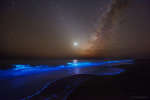 Night Glows
18.04.2017
What glows in the night? This night, several unusual glows were evident -- some near, but some far. The foreground surf glimmers blue with the light of bioluminescent plankton. Next out, Earth's atmosphere dims the horizon and provides a few opaque clouds. Further out, the planet Venus glows bright near the image center.
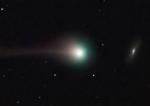 SWAN Meets Galaxy
19.10.2006
This cosmic portrait recorded October 9th features the lovely blue-green coma of Comet SWAN posing with spiral galaxy NGC 5005 in the northern constellation Canes Venatici. At the time the comet (center) was in the close foreground, a mere 9 light-minutes from planet Earth, with the galaxy a more substantial 60 million light-years distant.
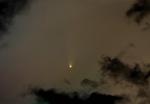 Comet McNaught Heads for the Sun
5.01.2007
Early morning risers with a clear and unobstructed eastern horizon can enjoy the sight of Comet McNaught (C/2006 P1) in dawn skies over the next few days. Discovered in August by R. H. McNaught...
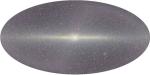 The Near Infrared Sky
18.05.2000
Was this picture taken from outside our Galaxy? No, it is a composite taken from Earth orbit, well inside our Milky Way Galaxy. In light just a little too red for human eyes...
 APOD: 2024 April 15 Б The Cigar Galaxy from Hubble and Webb
15.04.2024
Something strange happened to this galaxy, but what? Known as the Cigar Galaxy and cataloged as M82, red glowing gas and dust are being cast out from the center. Although this starburst galaxy...
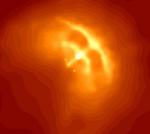 Vela Pulsar: Neutron Star-Ring-Jet
9.06.2000
This stunning image from the orbiting Chandra X-ray Observatory is centered on the Vela pulsar -- the collapsed stellar core within the Vela supernova remnant some 800 light-years distant. The Vela pulsar is a neutron star. More massive than the Sun, it has the
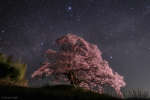 Summer Triangles over Japan
6.05.2015
Have you ever seen the Summer Triangle? The bright stars Vega, Deneb, and Altair form a large triangle on the sky that can be seen rising in the early northern early spring during the morning and rising in the northern fall during the evening.
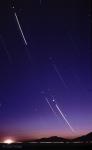 Trailing Planets
10.05.2002
Positioning his camera and tripod on planet Earth, near Maricopa, Arizona, USA, astrophotographer Joe Orman created this trailing display of the ongoing sky-full-of-planets on May 3rd. He initially captured the grouping in a 20 second long time exposure recording the positions of the bright planets and stars.
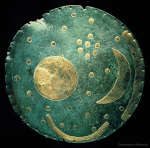 The Nebra Sky Disk
19.03.2018
It is considered the oldest known illustration of the night sky. But what, exactly, does it depict, and why was it made? The Nebra sky disk was found with a metal detector in 1999 by treasure hunters near Nebra, Germany, in the midst of several bronze-age weapons.
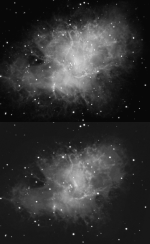 The Incredible Expanding Crab
27.12.2001
The Crab Nebula is cataloged as M1, the first on Charles Messier's famous list of things which are not comets. In fact, the Crab is now known to be a supernova remnant, an expanding cloud of debris from the explosion of a massive star.
|
January February March April May June July August September October |
|||||||||||||||||||||||||||||||||||||||||||||||||