
|
You entered: white dwarf
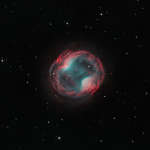 APOD: 2026 May 27 Б PK 164 +31.1: The Headphone Nebula
27.05.2026
What is a pair of headphones doing in the sky? TodayБs image features the Headphone Nebula, also known as PK 164 +31.1 or Jones-Emberson 1. This planetary nebula, the remnant of a dying Sun-like star, faintly occupies an angular region of the Lynx constellation about 1/5 th the diameter of the full moon.
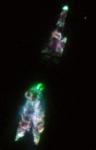 Emerging Planetary Nebula CRL 618
6.09.2000
CRL 618 may look to some like an Olympian declaring victory. Only a few hundred years ago, however, CRL 618 appeared as a relatively modest red giant star. Since then it has run out of core material to fuse and so has started to become a planetary nebula.
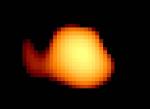 Resolving Mira
13.08.1997
Most stars appear only as points of light. Recently, Betelgeuse became the second star, after our Sun, to have it surface resolved. Now add Mira to the list. Mira A is a red giant star undergoing dramatic pulsations, causing it to become more than 100 times brighter over the course of a year.
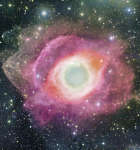 The Helix Nebula from CFHT
24.11.2020
Will our Sun look like this one day? The Helix Nebula is one of brightest and closest examples of a planetary nebula, a gas cloud created at the end of the life of a Sun-like star.
 Planetary Nebula Abell 7
23.01.2026
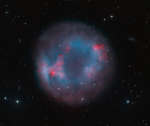
Very faint planetary nebula Abell 7 is about 1,800 light-years distant. It lies just south of Orion in planet Earth's skies toward the constellation Lepus, The Hare. Posing with scattered Milky Way stars, its generally simple spherical shape about 8 light-years in diameter is revealed in this deep telescopic image.
 Introducing Nova Velorum 1999
24.05.1999
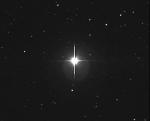
A bright nova was discovered Saturday that is currently visible to the unaided eye in southern skies. Nova Velorum 1999 was recorded near visual magnitude 3 independently by discoverers Peter Williams and Alan C. Gilmore (Mt. John U. Obs.), making it more luminous than many famous bright stars.
 The Helix Nebula in Hydrogen and Oxygen
13.02.2019
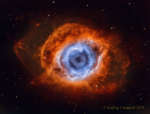
Is the Helix Nebula looking at you? No, not in any biological sense, but it does look quite like an eye. The Helix Nebula is so named because it also appears that you are looking down the axis of a helix.
 APOD: 2023 May 7 Б The Helix Nebula from CFHT
7.05.2023
Will our Sun look like this one day? The Helix Nebula is one of brightest and closest examples of a planetary nebula, a gas cloud created at the end of the life of a Sun-like star.
 M2-9: Wings of a Planetary Nebula
23.12.1997
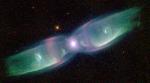
Are stars better appreciated for their art after they die? Actually, stars usually create their most artistic displays as they die. In the case of low-mass stars like our Sun and M2-9 pictured above, the stars transform themselves from normal stars to white dwarfs by casting off their outer gaseous envelopes.
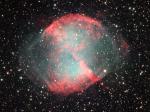 M27: The Dumbbell Nebula
3.06.2005
The first hint of what will become of our Sun was discovered inadvertently in 1764. At that time, Charles Messier was compiling a list of diffuse objects not to be confused with comets.
|
January February March April May June July August September |
|||||||||||||||||||||||||||||||||||||||||||||||||