
|
You entered: planetary nebula
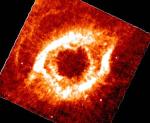 Infrared Helix
1.09.1997
Five hundred light years from Earth, in the constellation Aquarius, a sun-like star is dying. Its last few thousand years have produced the Helix, a well studied and nearby example of a Planetary Nebula - typical of this final phase of stellar evolution.
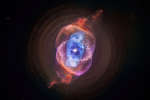 X Rays from the Cats Eye Nebula
4.08.2008
Haunting patterns within planetary nebula NGC 6543 readily suggest its popular moniker -- the Cat's Eye nebula. Starting in 1995, stunning false-color optical images from the Hubble Space Telescope detailed the swirls of this glowing nebula, known to be the gaseous shroud expelled from a dying sun-like star about 3,000 light-years from Earth.
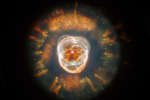 The Eskimo Nebula from Hubble
3.05.2009
In 1787, astronomer William Herschel discovered the Eskimo Nebula. From the ground, NGC 2392 resembles a person's head surrounded by a parka hood. In 2000, the Hubble Space Telescope imaged the Eskimo Nebula. From space, the nebula displays gas clouds so complex they are not fully understood.
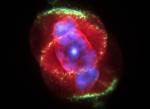 X-rays From The Cat's Eye
11.01.2001
Haunting patterns within planetary nebula NGC 6543 readily suggest its popular moniker -- the Cat's Eye nebula. In 1995, a stunning false-color optical image from the Hubble Space Telescope detailed the swirls of this glowing nebula, known to be the gaseous shroud expelled from a dying sun-like star about 3,000 light-years from Earth.
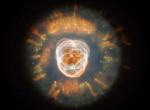 The Eskimo Nebula from the Newly Fixed Hubble
24.01.2000
In 1787, astronomer William Herschel discovered the Eskimo Nebula. From the ground, NGC 2392 resembles a person's head surrounded by a parka hood. In 2000, just after being fixed, the Hubble Space Telescope imaged the Eskimo Nebula. From space, the nebula displays gas clouds so complex they are not fully understood.
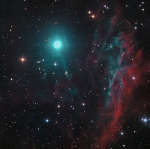 The Ghost of Jupiter s Halo
11.07.2019
Close-up images of NGC 3242 show the cast off shroud of a dying, sun-like star fancifully known as The Ghost of Jupiter nebula. But this deep and wide telescopic view also finds the seldom...
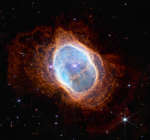 Webb s Southern Ring Nebula
14.07.2022
Cataloged as NGC 3132 the Southern Ring Nebula is a planetary nebula, the death shroud of a dying sun-like star some 2,500 light-years from Earth. Composed of gas and dust the stunning cosmic landscape is nearly half a light-year in diameter, explored in unprecedented detail by the James Webb Space Telescope.
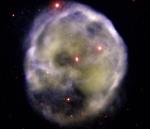 NGC 246 and the Dying Star
18.04.2006
Appropriately nicknamed "the Skull Nebula", planetary nebula NGC 246 really does surround a dying star some 1,600 light-years away in the constellation Cetus. Expelled over a period of thousands of years, the lovely, intricate nebula is the outer atmosphere of a once sun-like star.
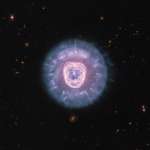 APOD: 2026 August 26 Б JWST Images The Lion's Head Nebula
26.08.2026
Are we looking at the future of our Sun? The James Webb Space Telescope captured todayБs composite image of the LionБs Head Nebula (NGC 2392) with its NIRCam and MIRI instruments. The LionБs Head Nebula is the remnant of a Sun-like star.
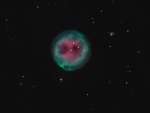 M97: The Owl Nebula
15.05.2009
The Owl Nebula is perched in the sky about 2,600 light-years away toward the bottom of the Big Dipper's bowl. Also cataloged as M97, the 97th object in Messier's well-known list, its round shape along with the placement of two large, dark "eyes" do suggest the face of a staring owl.
|
January February March April May June July August September |
|||||||||||||||||||||||||||||||||||||||||||||||||