
|
You entered: optical
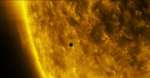 A Mercury Transit Music Video from SDO
11.05.2016
What's that small black dot moving across the Sun? Mercury. Possibly the clearest view of Mercury crossing in front of the Sun earlier this week was from Earth orbit. The Solar Dynamics Observatory obtained an uninterrupted vista recording it not only in optical light but also in bands of ultraviolet light.
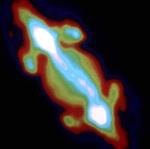 Radio Jupiter
9.10.2003
This view of gas giant Jupiter, made from data recorded at the Very Large Array radio observatory near Socorro, New Mexico, may not look too familiar. In fact, there is no sign of a bright, round planet striped with cloud bands, sporting a Great Red Spot.
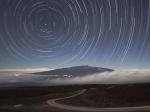 Star Trails Above Mauna Kea
20.12.2005
Is there a road to the stars? Possibly there are many, but the physical road pictured above leads up to the top of a dormant volcano that is a premier spot on planet Earth for observing stars and astronomical phenomena.
 LDN 988 and Friends
24.09.2015
Stars are forming in dark, dusty molecular cloud LDN 988. Seen near picture center some 2,000 light-years distant, LDN 988 and other nearby dark nebulae were cataloged by Beverly T. Lynds in 1962 using Palomar Observatory Sky Survey plates.
 APOD: 2025 March 4 Б A Quadruple Alignment over Italy
4.03.2025
Why does this Moon look so unusual? A key reason is its vivid red color. The color is caused by the deflection of blue light by Earth's atmosphere -- the same reason that the daytime sky appears blue. The Moon also appears unusually distorted.
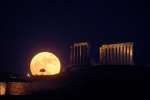 Solstice Moonrise, Cape Sounion
20.06.2008
Today's solstice marks the northernmost point of the Sun's annual motion through planet Earth's sky and the astronomical beginning of the northern hemisphere's summer. But only two days ago, the Full Moon nearest the solstice rose close to the ecliptic plane opposite the Sun, near its southernmost point for the year.
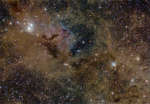 Stardust in Perseus
10.10.2015
This cosmic expanse of dust, gas, and stars covers some 6 degrees on the sky in the heroic constellation Perseus. At upper left in the gorgeous skyscape is the intriguing young star cluster IC 348 and neighboring Flying Ghost Nebula.
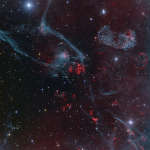 Puppis A Supernova Remnant
29.09.2017
Driven by the explosion of a massive star, supernova remnant Puppis A is blasting into the surrounding interstellar medium about 7,000 light-years away. At that distance, this colorful telescopic field based on broadband and narrowband optical image data is about 60 light-years across.
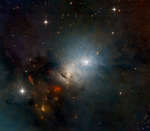 NGC 1333: Stellar Nursery in Perseus
11.11.2021
NGC 1333 is seen in visible light as a reflection nebula, dominated by bluish hues characteristic of starlight reflected by interstellar dust. A mere 1,000 light-years distant toward the heroic constellation Perseus, it lies at the edge of a large, star-forming molecular cloud.
 Runaway Star
27.11.1999
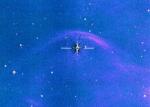
Runaway stars are massive stars traveling rapidly through interstellar space. Like a ship plowing through the interstellar medium, runaway star HD 77581 has produced this graceful arcing bow wave or "bow shock" - compressing the gaseous material in its path.
|
January February March April May June July August September |
|||||||||||||||||||||||||||||||||||||||||||||||||