
|
You entered: nearest stars
 Comet Lovejoy over The Great Wall
20.02.2014
Fading now as it returns to the outer solar system Comet Lovejoy (C/2013 R1) still graces planet Earth's sky, a delicate apparition in binoculars or small telescopes. The comet, a relic...
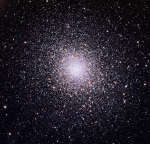 Messier 5
9.05.2019
"Beautiful Nebula discovered between the Balance [Libra] & the Serpent [Serpens] ..." begins the description of the 5th entry in 18th century astronomer Charles Messier's famous catalog of nebulae and star clusters. Though it appeared...
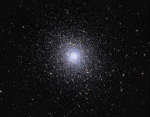 Messier 5
3.08.2012
"Beautiful Nebula discovered between the Balance [Libra] & the Serpent [Serpens] ..." begins the description of the 5th entry in 18th century astronomer Charles Messier's famous catalog of nebulae and star clusters. Though it appeared...
 Planetary Nebula NGC 2440
15.02.2007
Planetary nebula NGC 2440 has an intriguing bow-tie shape in this stunning view from space. The nebula is composed of material cast off by a dying sun-like star as it enters its white dwarf phase of evolution.
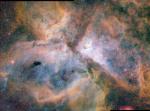 The Carina Nebula in Three Colors
17.07.2001
Stars, like people, do not always go gentle into that good night. The above Carina Nebula, also known as the Keyhole Nebula and NGC 3372, results from dying star Eta Carinae's violently casting off dust and gas during its final centuries.
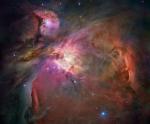 Orion Nebula, The Hubble View
19.01.2006
Few cosmic vistas excite the imagination like the Orion Nebula. Also known as M42, the nebula's glowing gas surrounds hot young stars at the edge of an immense interstellar molecular cloud only 1,500 light-years away.
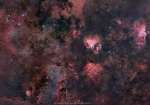 A Sagittarius Starscape
5.09.2014
This rich starscape spans nearly 7 degrees on the sky, toward the Sagittarius spiral arm and the center of our Milky Way galaxy. A telescopic mosaic, it features well-known bright nebulae and star clusters cataloged by 18th century cosmic tourist Charles Messier.
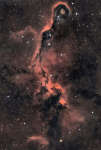 APOD: 2026 August 20 Б The Elephant s Trunk in Cepheus
20.08.2026
Like an illustration in a galactic Just So Story, the Elephant's Trunk Nebula winds through the emission region and young star cluster complex IC 1396, in the high and far off constellation of Cepheus. Also known as vdB 142, this cosmic elephant's trunk is over 20 light-years long.
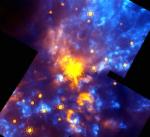 The Heart Of Orion
23.05.1997
Newborn stars lie at the heart of the Orion Nebula, hidden from view by the dust and gas of the giant Orion Molecular Cloud number 1 (OMC-1). Sensitive to invisible infrared wavelengths, Hubble...
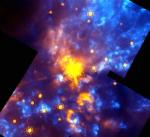 The Heart Of Orion
6.05.2000
Newborn stars lie at at the heart of the the Orion Nebula, hidden from view by the dust and gas of the giant Orion Molecular Cloud number 1 (OMC-1). Sensitive to invisible infrared...
|
January February March April May June July August September October |
|||||||||||||||||||||||||||||||||||||||||||||||||