
|
You entered: magnetic field
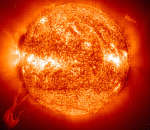 A Twisted Solar Eruptive Prominence
1.06.2008
Ten Earths could easily fit in the "claw" of this seemingly solar monster. The monster, though, visible on the lower left, is a huge eruptive prominence seen moving out from our Sun. The above dramatic image taken early in the year 2000 by the Sun-orbiting SOHO satellite.
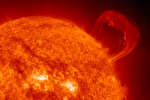 A Solar Prominence from SOHO
31.05.2009
How can gas float above the Sun? Twisted magnetic fields arching from the solar surface can trap ionized gas, suspending it in huge looping structures. These majestic plasma arches are seen as prominences above the solar limb.
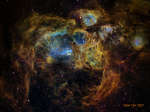 NGC 6357: The Lobster Nebula
25.12.2018
Why is the Lobster Nebula forming some of the most massive stars known? No one is yet sure. Cataloged as NGC 6357, the Lobster Nebula houses the open star cluster Pismis 24 near its center -- a home to unusually bright and massive stars.
 APOD: 2023 August 1 Б Monster Solar Prominence
31.07.2023
The monsters that live on the Sun are not like us. They are larger than the Earth and made of gas hotter than in any teapot. They have no eyes, but at times, many tentacles. They float. Usually, they slowly change shape and just fade back onto the Sun over about a month.
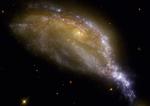 A Galaxy Collision in NGC 6745
1.11.2000
Galaxies don't normally look like this. NGC 6745 actually shows the results of two galaxies that have been colliding for only hundreds of millions of years. Just off the above photograph to the lower right is the smaller galaxy, moving away.
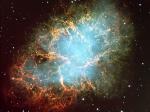 The Crab Nebula from VLT
14.07.2002
The Crab Nebula, filled with mysterious filaments, is the result of a star that was seen to explode in 1054 AD. This spectacular supernova explosion was recorded by Chinese and (quite probably) Anasazi Indian astronomers.
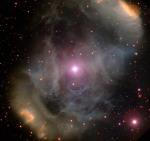 NGC 6164: A Bipolar Emission Nebula
6.06.2006
How did a star form this beautiful nebula? In the middle of emission nebula NGC 6164-5 is an unusually massive star nearing the end of its life. The star, visible in the center...
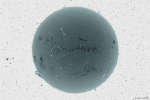 Dark Ball in Inverted Starfield
5.11.2022
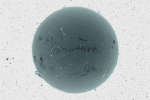
Does this strange dark ball look somehow familiar? If so, that might be because it is our Sun. In the featured image from 2012, a detailed solar view was captured originally in a very specific color of red light, then rendered in black and white, and then color inverted.
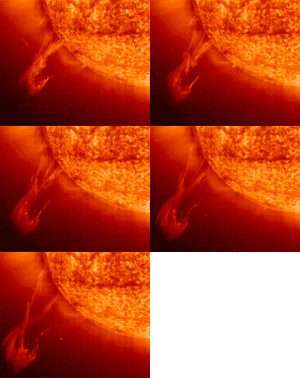 A Twisted Solar Eruptive Prominence
3.04.2000
A huge eruptive prominence is seen moving out from our Sun in this condensed half-hour time-lapse sequence. Ten Earths could easily fit in the "claw" of this seemingly solar monster. This large prominence, though, is significant not only for its size, but its shape.
 Black Sun and Inverted Starfield
15.10.2012
Does this strange dark ball look somehow familiar? If so, that might be because it is our Sun. In the above image, a detailed solar view was captured originally in a very specific color of red light, then rendered in black and white, and then color inverted.
|
January February March April May June July August September October |
|||||||||||||||||||||||||||||||||||||||||||||||||