
|
You entered: distance
 Hubble's Constant And The Expanding Universe (I)
13.05.1996
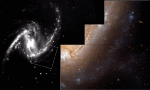
Our Universe is expanding. Distant galaxies appear to recede from us at ever-increasing speeds. What is the rate of expansion? How long has it been expanding? What will be its ultimate fate? Two groups of astronomers are searching vigorously for answers to these fundamental questions using the Hubble Space Telescope (HST).
 Magnetars In The Sky
25.11.2004
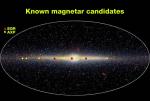
Indicated on this infrared image of the galactic center region are positions of candidate magnetars -- believed to be the strongest magnets in the galaxy. Classified by observers as Soft Gamma Repeaters (SGRs) and Anomalous X-ray Pulsars (AXPs), these cosmic powerhouses are likely city-sized, spinning, highly-magnetized neutron stars. How strong is a magnetar's magnetic field?
 Magnetars In The Sky
1.09.2001
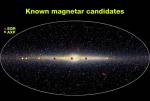
Indicated on this infrared image of the galactic center region are positions of candidate magnetars -- believed to be the strongest magnets in the galaxy. Classified by observers as Soft Gamma Repeaters (SGRs) and Anomalous X-ray Pulsars (AXPs), these cosmic powerhouses are likely city-sized, spinning, highly-magnetized neutron stars. How strong is a magnetar's magnetic field?
 Hubble's Constant And The Expanding Universe (II)
14.05.1996
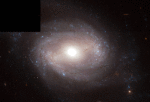
In this century, the discovery that the Universe is expanding has produced a revolution in human thought about the Cosmos. American astronomer Edwin Hubble played a major role in this profound discovery, coining the "Hubble constant".
 Henrietta Leavitt Calibrates the Stars
3.09.2000
Humanity's understanding of the relative brightness and variability of stars was revolutionized by the work of Henrietta Swan Leavitt (1868-1921). Working at Harvard College Observatory, Leavitt precisely calibrated the photographic magnitudes of 47 stars to which all other stars could be compared.
 Henrietta Leavitt Calibrates the Stars
26.10.1998
Humanity's understanding of the relative brightness and variability of stars was revolutionized by the work of Henrietta Swan Leavitt (1868-1921). Working at Harvard College Observatory, Leavitt precisely calibrated the photographic magnitudes of 47 stars to which all other stars could be compared.
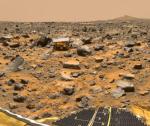 At Work on Mars
14.07.1998
To learn about the history ofMars, just ask the rocks. Last year, that's exactly what the robot rover Sojourner did. Sojouner can be seen, above, analyzing a rock nicknamed Moe, trying to discern its past.
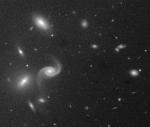 A Peculiar Cluster of Galaxies
29.09.1998
Far across the universe, an unusual cluster of galaxies has been evolving. A diverse group of galaxies populate this cluster, including, on the left, an unusual galaxy showing an equatorial polar ring and a large spiral. Above looms a large elliptical galaxy.
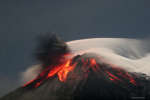 Tungurahua Erupts
2.04.2012
Volcano Tungurahua sometimes erupts spectacularly. Pictured above, molten rock so hot it glows visibly pours down the sides of the 5,000-meter high Tungurahua, while a cloud of dark ash is seen being ejected toward the left. Wispy white clouds flow around the lava-lit peak, while a star-lit sky shines in the distance.
 Apollo 12 Visits Surveyor 3
23.11.1996
Apollo 12 was the second mission to land humans on the Moon. The landing site was picked to be near the location of Surveyor 3, a robot spacecraft that had landed on the moon three years earlier. Pictured above, Apollo 12 astronauts Conrad and Bean retrieve parts from the Surveyor.
|
January February March April May June July August |
||||||||||||||||||||||||||||||||||||||||||||||||||||||||