
|
You entered: dark energy
 The Matter of Galaxy Clusters
24.10.2001
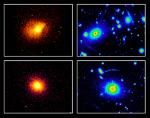
Situated over 2,000,000,000 (two billion) light-years from Earth, galaxies in cluster Abell 2390 (top) and MS2137.3-2353 (bottom) are seen in the right hand panels above, false-color images from the Hubble Space Telescope. Corresponding panels on the left reveal each cluster's x-ray appearance in images from the Chandra X-ray Observatory.
 The Flame Nebula in Visible and Infrared
8.12.2014
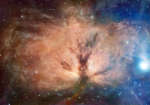
What lights up the Flame Nebula? Fifteen hundred light years away towards the constellation of Orion lies a nebula which, from its glow and dark dust lanes, appears, on the left, like a billowing fire. But fire, the rapid acquisition of oxygen, is not what makes this Flame glow.
 3C 295: X-rays From A Giant Galaxy
25.11.1999
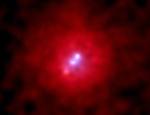
Did this galaxy eat too much? Five billion light-years away, the giant elliptical galaxy 3C295 is a prodigious source of energy at radio wavelengths. Bright knots of X-ray emission are also seen at the center of this false-color Chandra Observatory image of the region.
 Fornax Cluster in Motion
24.09.2004
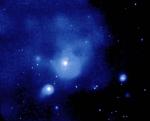
Reminiscent of popular images of the lovely Pleiades star cluster that lies within our own Milky Way Galaxy, this false-color x-ray view actually explores the center of a much more extended cosmic family -- the Fornax cluster of galaxies some 65 million light-years away.
 The Center of Centaurus A
1.10.2000
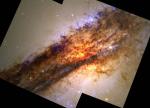
A fantastic jumble of young blue star clusters, gigantic glowing gas clouds, and imposing dark dust lanes surrounds the central region of the active galaxy Centaurus A. This mosaic of Hubble Space Telescope images taken in blue, green, and red light has been processed to present a natural color picture of this cosmic maelstrom.
 The Center of Centaurus A
22.05.1998
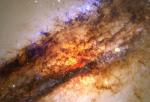
A fantastic jumble of young blue star clusters, gigantic glowing gas clouds, and imposing dark dust lanes surrounds the central region of the active galaxy Centaurus A. This mosaic of Hubble Space Telescope images taken in blue, green, and red light has been processed to present a natural color picture of this cosmic maelstrom.
 ROSAT Explores The X-Ray Sky
19.08.2000
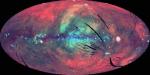
Launched in 1990, the orbiting ROSAT observatory explored the Universe by viewing the entire sky in x-rays -- photons with about 1,000 times more energy than visible light. This ROSAT survey produced the sharpest, most sensitive image of the x-ray sky to date.
 The Center of Centaurus A
21.04.2002
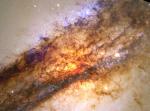
A fantastic jumble of young blue star clusters, gigantic glowing gas clouds, and imposing dark dust lanes surrounds the central region of the active galaxy Centaurus A. This mosaic of Hubble Space Telescope images taken in blue, green, and red light has been processed to present a natural color picture of this cosmic maelstrom.
 ROSAT Explores The X-Ray Sky
8.10.1996
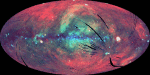
Launched in 1990, the orbiting ROSAT observatory explored the Universe by viewing the entire sky in x-rays - photons with about 1,000 times more energy than visible light. This ROSAT survey produced the sharpest, most sensitive image of the x-ray sky to date.
 The Center of Centaurus A
17.07.2005
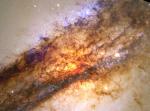
A fantastic jumble of young blue star clusters, gigantic glowing gas clouds, and imposing dark dust lanes surrounds the central region of the active galaxy Centaurus A. This mosaic of Hubble Space Telescope images taken in blue, green, and red light has been processed to present a natural color picture of this cosmic maelstrom.
|
January February March April May June July August September |
|||||||||||||||||||||||||||||||||||||||||||||||||