
|
You entered: composite image
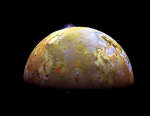 Io: The Prometheus Plume
22.05.2011
What's happening on Jupiter's moon Io? Two sulfurous eruptions are visible on Jupiter's volcanic moon Io in this color composite image from the robotic Galileo spacecraft that orbited Jupiter from 1995 to 2003.
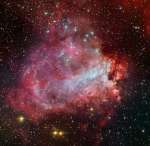 Star Factory Messier 17
22.10.2015
Sculpted by stellar winds and radiation, the star factory known as Messier 17 lies some 5,500 light-years away in the nebula-rich constellation Sagittarius. At that distance, this 1/3 degree wide field of view spans over 30 light-years.
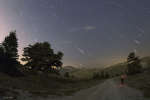 Perseid Meteors over Turkey
1.08.2017
The Perseid Meteor Shower, usually the best meteor shower of the year, will peak late next week. A person watching a clear sky from a dark location might see a bright meteor every minute.
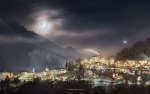 A Lunar Corona with Jupiter and Saturn
19.01.2021
Why does a cloudy moon sometimes appear colorful? The effect, called a lunar corona, is created by the quantum mechanical diffraction of light around individual, similarly-sized water droplets in an intervening but mostly-transparent cloud. Since light of different colors has different wavelengths, each color diffracts differently.
 NGC 6822: Barnard s Galaxy
2.12.2021
Grand spiral galaxies often seem to get all the glory, flaunting their young, bright, blue star clusters in beautiful, symmetric spiral arms. But small galaxies form stars too, like nearby NGC 6822, also known as Barnard's Galaxy.
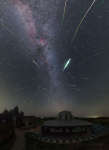 Perseid Meteors over Slovakia
12.08.2019
Tonight is a good night to see meteors. Comet dust will rain down on planet Earth, streaking through dark skies during the peak of the annual Perseid Meteor Shower. The featured composite image was taken during last year's Perseids from the Poloniny Dark Sky Park in Slovakia.
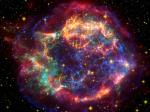 Cassiopeia A Light Echoes in Infrared
15.06.2005
Why is the image of Cassiopeia A changing? Two images of the nearby supernova remnant taken a year apart in infrared light appear to show outward motions at tremendous speeds. This was unexpected since the supernova that created the picturesque nebula was seen 325 years ago. The reason is likely light echoes.
 APOD: 2025 April 8 Б Moon Visits Sister Stars
8.04.2025
Sometimes, the Moon visits the Pleiades. Technically, this means that the orbit of our Moon takes it directly in front of the famous Pleiades star cluster, which is far in the distance. The technical...
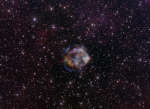 Cas A: Optical and X ray
17.01.2013
The aftermath of a cosmic cataclysm, supernova remnant Cassiopeia A (Cas A) is a comfortable 11,000 light-years away. Light from the Cas A supernova, the death explosion of a massive star, first reached Earth just 330 years ago.
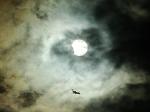 Clouds, Plane, Sun, Eclipse
11.04.2005
How can part of the Sun just disappear? When that part is really hiding behind the Moon. Last Friday, the first partial solar eclipse of 2005 and the last total eclipse of the Sun until March 2006 was visible. During a solar eclipse, the Sun, Moon and Earth are aligned.
|
January February March April May June July August September |
|||||||||||||||||||||||||||||||||||||||||||||||||