
|
You entered: clouds
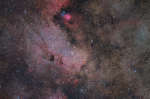 Messier 24: Sagittarius Star Cloud
18.07.2024
Unlike most entries in Charles Messier's famous catalog of deep sky objects, M24 is not a bright galaxy, star cluster, or nebula. It's a gap in nearby, obscuring interstellar dust clouds that allows a view of the distant stars in the Sagittarius spiral arm of our Milky Way galaxy.
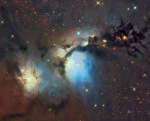 M78 and Reflecting Dust Clouds in Orion
2.03.2010
An eerie blue glow and ominous columns of dark dust highlight M78 and other bright reflection nebula in the constellation of Orion. The dark filamentary dust not only absorbs light, but also reflects the light of several bright blue stars that formed recently in the nebula.
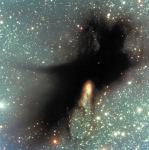 BHR 71: Stars, Clouds, and Jets
27.01.2003
What is happening to molecular cloud BHR 71? Quite possible, a binary star system is forming inside. Most stars in our Galaxy are part of binary star systems, but few have ever been seen in formation.
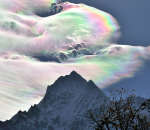 Iridescent Clouds over Thamserku
8.07.2014
Why would a cloud appear to be different colors? A relatively rare phenomenon known as iridescent clouds can show unusual colors vividly or a whole spectrum of colors simultaneously. These clouds are formed of small water droplets of nearly uniform size.
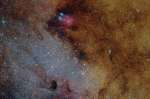 Messier 24: Sagittarius Star Cloud
29.06.2018
Unlike most entries in Charles Messier's famous catalog of deep sky objects, M24 is not a bright galaxy, star cluster, or nebula. It's a gap in nearby, obscuring intertellar dust clouds that allows a view of the distant stars in the Sagittarius spiral arm of our Milky Way galaxy.
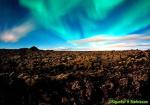 Aurora Over Clouds
2.04.2001
Aurorae usually occur high above the clouds. The auroral glow is created when fast-moving particles ejected from the Sun impact air molecules high in the Earth's atmosphere. An oxygen molecule, for example, will glow in a green light when reacquiring an electron lost during a collision with a solar particle.
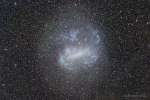 APOD: 2023 March 7 Б Deep Field: The Large Magellanic Cloud
7.03.2023
Is this a spiral galaxy? No. Actually, it is the Large Magellanic Cloud (LMC), the largest satellite galaxy of our own Milky Way Galaxy. The LMC is classified as a dwarf irregular galaxy because of its normally chaotic appearance. In this deep and wide exposure, however, the full extent of the LMC becomes visible.
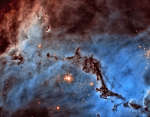 N11: Star Clouds of the LMC
11.02.2013
Massive stars, abrasive winds, mountains of dust, and energetic light sculpt one of the largest and most picturesque regions of star formation in the Local Group of Galaxies. Known as N11, the region...
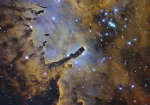 NGC 6823: Cloud Sculpting Star Cluster
8.10.2014
Star cluster NGC 6823 is slowly turning gas clouds into stars. The center of the open cluster, visible on the upper right, formed only about two million years ago and is dominated in brightness by a host of bright young blue stars.
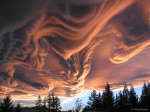 Asperitas Clouds Over New Zealand
19.08.2018
What kind of clouds are these? Although their cause is presently unknown, such unusual atmospheric structures, as menacing as they might seem, do not appear to be harbingers of meteorological doom. Formally recognized as a distinct cloud type only last year, Asperitas clouds can be stunning in appearance, unusual in occurrence, and are relatively unstudied.
|
January February March April May June July August September |
|||||||||||||||||||||||||||||||||||||||||||||||||