
|
You entered: Elliptical Galaxy
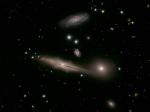 Galaxy Group HCG 87
31.07.2003
Posing for this cosmic family photo are the galaxies of HCG (Hickson Compact Group) 87, about four hundred million light-years distant toward the amphibious constellation Capricornus. The large edge-on spiral near picture center...
 Galaxies in the Furnace
4.12.2025
An example of violence on a cosmic scale, enormous elliptical galaxy NGC 1316 lies about 75 million light-years away toward Fornax, the southern constellation of the Furnace. Investigating the startling sight, astronomers suspect...
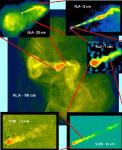 The Large and Small of M87
16.02.1999
The small core of elliptical galaxy M87 appears to be energizing its whole galactic neighborhood. Recent images from the Very Large Array (VLA) of radio telescopes indicate that huge bubbles of hot gas not only exist but are still being created. These bubbles measure 200,000 light-years across and surround the entire galaxy.
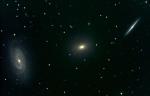 Three Galaxies in Draco
8.06.2001
This intriguing trio of galaxies is sometimes called the NGC 5985/Draco Group and so (quite reasonably) is located in the northern constellation Draco. From left to right are face-on spiral NGC 5985, elliptical galaxy...
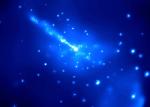 Centaurus A: X-Rays from an Active Galaxy
5.07.2003
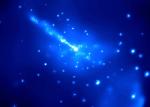
Its core hidden from optical view by a thick lane of dust, the giant elliptical galaxy Centaurus A was among the first objects observed by the orbiting Chandra X-ray Observatory. Astronomers were not disappointed, as Centaurus A's appearance in x-rays makes its classification as an active galaxy easy to appreciate.
 Centaurus A: X Rays from an Active Galaxy
16.08.2001
Its core hidden from optical view by a thick lane of dust, the giant elliptical galaxy Centaurus A was among the first objects observed by the orbiting Chandra X-ray Observatory. Astronomers were not disappointed, as Centaurus A's appearance in x-rays makes its classification as an active galaxy easy to appreciate.
 Three Galaxies in Draco
1.07.2009
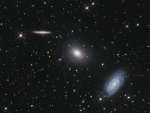
This intriguing trio of galaxies is sometimes called the Draco Group, located in the northern constellation of (you guessed it) Draco. From left to right are edge-on spiral NGC 5981, elliptical galaxy NGC 5982...
 Galaxies Of The Virgo Cluster
26.01.2001
Well over a thousand galaxies are known members of the Virgo Cluster, the closest large cluster of galaxies to our own local group. The galaxy cluster is difficult to see all at once because it covers such a large area on the sky.
 Galaxy Group HCG 87
16.07.2005
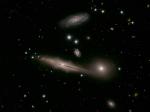
Posing for this cosmic family photo are the galaxies of HCG (Hickson Compact Group) 87, about four hundred million light-years distant toward the amphibious constellation Capricornus. The large edge-on spiral near picture center...
 The Clash of NGC 3256
7.06.2018
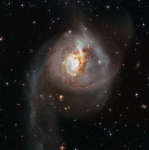
Marked by an unusually bright central region, swirling dust lanes, and far flung tidal tails, peculiar NGC 3256 is the aftermath of a truly cosmic collision. The 500 million year old clash of two separate galaxies spans some 100 thousand light-years in this sharp Hubble view.
|
January February March April May June July August September |
|||||||||||||||||||||||||||||||||||||||||||||||||