
|
You entered: Deep Sky
 APOD: 2025 July 9 Б A Beautiful Trifid
9.07.2025
The beautiful Trifid Nebula is a cosmic study in contrasts. Also known as M20, it lies about 5,000 light-years away toward the nebula rich constellation Sagittarius. A star forming region in the plane...
 Galaxies, Stars, and Dust
13.10.2012
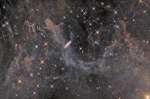
Spiky stars and spooky shapes abound in this deep cosmic skyscape. Its well-composed field of view covers about 2 Full Moons on the sky toward the constellation Pegasus. Of course the brighter stars show diffraction spikes, the commonly seen effect of internal supports in reflecting telescopes, and lie well within our own Milky Way galaxy.
 Cat s Eye Wide and Deep
28.05.2016
The Cat's Eye Nebula (NGC 6543) is one of the best known planetary nebulae in the sky. Its more familiar outlines are seen in the brighter central region of the nebula in this impressive wide-angle view. But the composite image combines many short and long exposures to also reveal an extremely faint outer halo.
 Galaxy, Stars, and Dust
12.10.2015
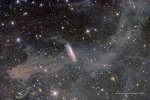
Is this galaxy trapped in a web of dust? No -- it is far in the background. However, spiky stars and spooky shapes are abound in this deep cosmic skyscape. Its well-composed field of view covers about a Full Moon on the sky toward the constellation Pegasus.
 APOD: 2026 June 17 Б Longmore 8: The Hamster Wheel Nebula
17.06.2026
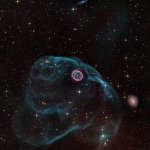
How did a hamster wheel get into space? The Hamster Wheel Nebula (Longmore 8) was discovered by Andrew Longmore in 1976 as a part of a larger survey of the southern sky. This survey...
 Deepscape at Yacoraite
8.05.2021
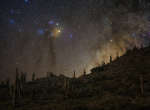
In this evocative night scene a dusty central Milky Way rises over the ancient Andean archaeological site of Yacoraite in northwestern Argentina. The denizens of planet Earth reaching skyward are the large Argentine saguaro cactus currently native to the arid region.
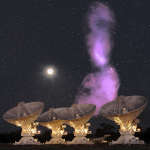 Centaurus Radio Jets Rising
13.04.2011
What if you could see the huge radio jets of Centaurus A rising? The Cen A radio jets are not only over a million light years long, they occupy an angular area over 200 times greater than the full Moon in Earth's sky.
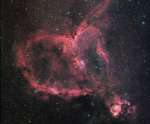 IC 1805: The Heart Nebula
14.02.2009
Sprawling across almost 200 light-years, emission nebula IC 1805 is a mix of glowing interstellar gas and dark dust clouds. Derived from its Valentine's-Day-approved shape, its nickname is the Heart Nebula. About 7,500 light-years away in the Perseus spiral arm of our galaxy, stars were born in IC 1805.
 Andromeda in a Single Shot
25.06.2021
How far can you see? The Andromeda Galaxy, 2.5 million light years away, is the most distant object easily seen by the unaided eye. Other denizens of the night sky, like stars, clusters, and nebulae, are typically hundreds to thousands of light-years distant.
 APOD: 2024 March 18 Б Comet Pons Brooks Swirling Coma
18.03.2024
A bright comet will be visible during next month's total solar eclipse. This very unusual coincidence occurs because Comet 12P/Pons-Brooks's return to the inner Solar System places it by chance only 25 degrees away from the Sun during Earth's April 8 total solar eclipse.
|
January February March April May June July August September October |
|||||||||||||||||||||||||||||||||||||||||||||||||