
|
You entered: planet
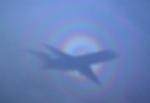 The Giant and the Glory
6.08.2004
On a flight from Vienna to Brussels, astronomer Franz Kerschbaum looked out the window and photographed this beautiful atmospheric phenomenon, the glory, shining in the direction directly opposite the Sun. Before airplanes, the glory, known to some as the heiligenschein or the Specter of the Brocken, was occasionally seen from mountaintops.
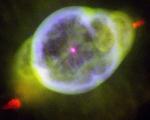 NGC 3242: The Ghost of Jupiter
29.10.2005
After a star like the Sun completes fusion in its core, it throws off its outer layers in a brief, beautiful cosmic display called a planetary nebula. NGC 3242 is such a planetary nebula, with the stellar remnant white dwarf star visible at the center.
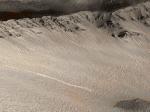 A Year of Extraterrestrial Fountains and Flows
30.12.2006
The past year was extraordinary for the discovery of extraterrestrial fountains and flows -- some offering new potential in the search for liquid water and the origin of life beyond planet Earth.. Increased evidence was uncovered that fountains spurt not only from Saturn's moon Enceladus, but from the dunes of Mars as well.
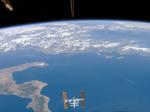 Space Station Over the Ionian Sea
26.11.2007
Last August, the Space Shuttle Endeavor crew captured this shot of the International Space Station (ISS) against the backdrop of Planet Earth. During that trip to the ISS, the space shuttle crew re-supplied the station, repaired the station, and even built more of the station.
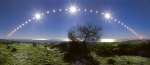 Tyrrhenian Sea and Solstice Sky
21.12.2007
Today the Solstice occurs at 0608 Universal Time, the Sun reaching its southernmost declination in planet Earth's sky. Of course, the December Solstice marks the beginning of winter in the northern hemisphere and summer in the south.
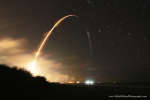 A Launch and a Landing
27.09.2014
Taken from an Atlantic beach, Cape Canaveral, planet Earth, four identically framed digital images are combined in this night skyscape. Slightly shifted short star trails dot the sky, but the exposure times were adjusted to follow the flight of a Falcon 9 rocket.
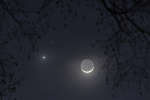 Love and War by Moonlight
25.02.2015
Venus, named for the Roman goddess of love, and Mars, the war god's namesake, came together by moonlight in this lovely skyview, recorded on February 20 from Charleston, South Carolina, USA, planet Earth.
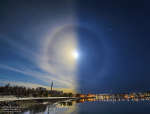 Sun and Moon Halo
2.04.2015
Two pictures captured on April 1 are combined in this creative day and night composite. Separated in time by about 10 hours the images otherwise match, looking along the coast at Östersund Sweden.
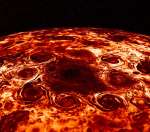 Cyclones at Jupiter s North Pole
7.03.2018
Juno's Jovian Infrared Auroral Mapper data was used to construct this stunning view of cyclones at Jupiter's North Pole. Measuring the thermal emission from Jovian cloud tops, the infrared the observations are not restricted to the hemisphere illuminated by sunlight.
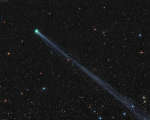 Long Tailed Comet SWAN
7.05.2020
Blowing in the solar wind the spectacular ion tail of Comet SWAN (C/2020 F8) extends far across this 10 degree wide telephoto field of view. Captured on May 2 its greenish coma was about 6 light-minutes from Earth. The pretty background starfield lies near the border of the constellations Cetus and Aquarius.
|
January February March April May June July August September |
|||||||||||||||||||||||||||||||||||||||||||||||||