
|
You entered: space
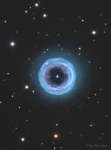 APOD: 2026 March 4 Б Shapley 1: An Annular Planetary Nebula
4.03.2026
WhatБs looking back at you isnБt a cosmic eye, but Shapley 1, a beautifully symmetric planetary nebula. Shapley 1, also known as the Fine Ring Nebula or PLN 329+2.1, bejewels the southern sky constellation of the Carpenter's Square (Norma).
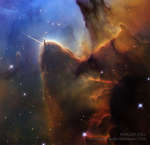 APOD: 2026 May 3 Б Trifid Pillars and Jets
3.05.2026
Dust pillars are like interstellar mountains. They survive because they are more dense than their surroundings, but they are slowly being eroded away by a hostile environment. Visible in the featured picture...
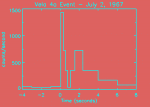 Gamma Ray Burst: A Milestone Explosion
2.07.2000
Gamma-Ray Bursts (GRBs) were discovered by accident. Thirty three years ago today, satellites first recorded a GRB. The data plotted here show that the count rate of the satellite gamma-ray instrument abruptly jumped indicating a sudden flash of gamma-rays.
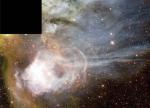 N44C: A Nebular Mystery
14.05.2002
Why is N44C glowing so strangely? The star that appears to powers the nebula, although young and bright, does not seem hot enough to create some of the colors observed. A search for a hidden hotter star in X-rays has come up empty.
 Europa: Oceans of Life?
6.08.1996
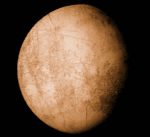
Is there life beneath Europa's frozen surface? Some believe the oceans found there of carbon-enriched water are the best chance for life, outside the Earth, in our Solar System. Europa, the fourth largest moon of Jupiter, was recently discovered to have a thin oxygen atmosphere by scientists using the Hubble Space Telescope.
 Seyfert's Sextet
24.01.2003
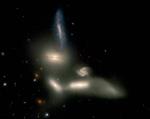
Known as Seyfert's Sextet, this intriguing group of galaxies lies in the head portion of the split constellation Serpens. The sextet actually contains only four interacting galaxies, though. Near the center of this...
 GRB 990123 Host Galaxy Imaged
10.02.1999
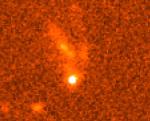
Do the powerful explosions known as gamma-ray bursts (GRBs) originate in galaxies? This subject took on new light yesterday with the release of a Hubble Space Telescope image of the sky surrounding GRB 990123. This burst was first detected only two weeks ago and cataloged as one of the most powerful GRBs ever.
 Descent to Titan
14.01.2005
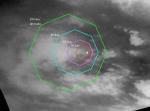
Today's descent to the surface of Titan by the European Space Agency's Huygens probe is the most distant landing ever attempted by a spacecraft from Earth. At 10:13 UT (5:13am...
 M51: Cosmic Whirlpool
28.04.2005
Follow the handle of the Big Dipper away from the dipper's bowl, until you get to the handle's last bright star. Then, just slide your telescope a little south and west and you might find this stunning pair of interacting galaxies, the 51st entry in Charles Messier's famous catalog.
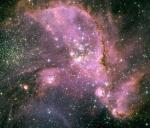 Young Stars of NGC 346
17.11.2005
Star cluster NGC 346 is embedded in the largest star forming region in the Small Magellanic Cloud, some 210,000 light-years distant. The massive stars of NGC 346 are short lived, but very energetic.
|
January February March April May June July August September |
|||||||||||||||||||||||||||||||||||||||||||||||||