
|
You entered: Milky Way
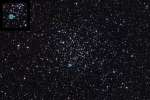 Stars Young and Old
26.03.2009
Galactic or open star clusters are relatively young. These swarms of stars are born near the plane of the Milky Way, but their numbers steadily dwindle as cluster members are strewn through the Galaxy by gravitational interactions.
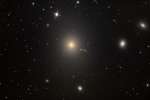 M87: Elliptical Galaxy with Jet
20.05.2010
In spiral galaxies, majestic winding arms of young stars, gas, and dust rotate in a flat disk around a bulging galactic nucleus. But elliptical galaxies seem to be simpler. Lacking gas and dust to form new stars, their randomly swarming older stars, give them an ellipsoidal (egg-like) shape. Still, elliptical galaxies can be very large.
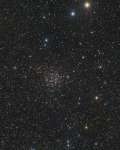 NGC 7789: Caroline s Rose
26.10.2013
Found among the rich starfields of the Milky Way toward the constellation Cassiopeia, star cluster NGC 7789 lies about 8,000 light-years away. A late 18th century deep sky discovery of astronomer Caroline Lucretia Herschel, the cluster is also known as Caroline's Rose.
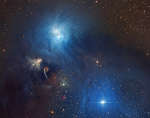 Stars and Dust in Corona Australis
7.01.2015
Cosmic dust clouds and young, energetic stars inhabit this telescopic vista, less than 500 light-years away toward the northern boundary of Corona Australis, the Southern Crown. The dust clouds effectively block light from more distant background stars in the Milky Way.
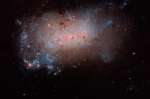 NGC 4449: Close up of a Small Galaxy
14.07.2017
(xxxedit and linkxxx) Grand spiral galaxies often seem to get all the glory. Their young, blue star clusters and pink star forming regions along sweeping spiral arms are guaranteed to attract attention. But small irregular galaxies form stars too, like NGC 4449, about 12 million light-years distant.
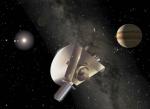 New Horizons at Jupiter
4.12.2003
Headed for the first close-up exploration of the Pluto-Charon system and the icy denizens of the Kuiper belt, NASA's New Horizons spacecraft is pictured here in an artist's vision of the robot probe outward bound.
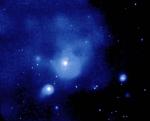 Fornax Cluster in Motion
24.09.2004
Reminiscent of popular images of the lovely Pleiades star cluster that lies within our own Milky Way Galaxy, this false-color x-ray view actually explores the center of a much more extended cosmic family -- the Fornax cluster of galaxies some 65 million light-years away.
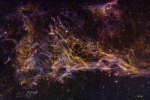 Pickerings Triangle from Kitt Peak
1.07.2008
Wisps like this are all that remain visible of a Milky Way star. About 7,500 years ago that star exploded in a supernova leaving the Veil Nebula, also known as the Cygnus Loop.
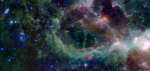 Galaxies Beyond the Heart: Maffei 1 and 2
9.03.2010
The two galaxies on the far left were unknown until 1968. Although they would have appeared as two of the brighter galaxies on the night sky, the opaque dust of the central band of our Milky Way Galaxy had obscured them from being seen in visible light.
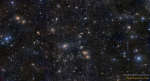 Virgo Cluster Galaxies
4.08.2015
Well over a thousand galaxies are known members of the Virgo Cluster, the closest large cluster of galaxies to our own local group. In fact, the galaxy cluster is difficult to appreciate all at once because it covers such a large area on the sky.
|
January February March April May June July August September October |
|||||||||||||||||||||||||||||||||||||||||||||||||