
|
You entered: nebula
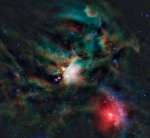 Young Stars in the Rho Ophiuchi Cloud
14.04.2011
Dust clouds and embedded newborn stars glow at infrared wavelengths in this tantalizing false-color composition from WISE, the Wide-field Infrared Survey Explorer. The cosmic canvas features one of the closest star forming regions, part of the Rho Ophiuchi cloud complex some 400 light-years distant near the southern edge of the pronounceable constellation Ophiuchus.
 APOD: 2025 June 23 Б W5: Pillars of Star Formation
23.06.2025
How do stars form? Images of the star forming region W5 like those in the infrared by NASA's Wide Field Infrared Survey Explorer (WISE, later NEOWISE) satellite provide clear clues with indications that massive stars near the center of empty cavities are older than stars near the edges.
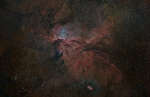 NGC 6188 and NGC 6164
1.02.2014
Fantastic shapes lurk in clouds of glowing gas in NGC 6188, about 4,000 light-years away. The emission nebula is found near the edge of a large molecular cloud unseen at visible wavelengths, in the southern constellation Ara.
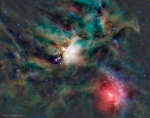 Young Stars in the Rho Ophiuchi Cloud
17.11.2019
How do stars form? To help find out, astronomers created this tantalizing false-color composition of dust clouds and embedded newborn stars in infrared wavelengths with WISE, the Wide-field Infrared Survey Explorer. The cosmic canvas...
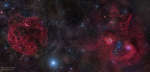 Downtown Auriga
13.02.2014
Rich in star clusters and nebulae, the ancient constellation of Auriga, the Charioteer, rides high in northern winter night skies. Spanning nearly 24 full moons (12 degrees) on the sky, this deep telescopic mosaic view recorded in January shows off some of Auriga's most popular sights for cosmic tourists.
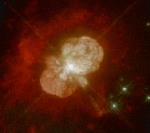 Eta Carinae Before Explosion
12.07.1995
The star Eta Carinae, at the center of the photo, will likely destroy itself in a spectacular explosion in a few million years - or sooner! Currently it is one of the brightest, most massive, and least stable stars known. Much of the gas in this Hubble Space Telescope photograph was blown off the star itself.
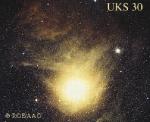 Antares
24.06.1997
Antares is a huge star. In a class called red supergiant, Antares is about 700 times the size of our own Sun, 15 times more massive, and 10,000 times brighter. Antares is the brightest star in the constellation of Scorpius and one of the brighter stars in all the night sky.
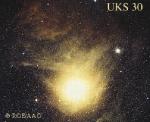 Antares
26.07.1998
Antares is a huge star. In a class called red supergiant, Antares is about 700 times the diameter of our own Sun, 15 times more massive, and 10,000 times brighter. Antares is the brightest star in the constellation of Scorpius and one of the brighter stars in all the night sky.
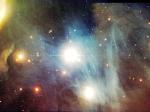 A Chamaeleon Sky
9.06.2002
A photogenic group of nebulae can be found toward Chamaeleon, a constellation visible predominantly in skies south of the Earth's equator. Celestial objects visible there include the blue reflection nebulas highlighted by thin dust surrounding the bright stars in the above image center.
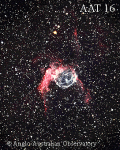 A Wolf Rayet Star Bubble
28.09.1997
What's a Wolf-Rayet star, and how did it create that spherical bubble and sweeping arc? A Wolf-Rayet star is a star that originated with a mass over 40 times that of our Sun.
|
January February |
|||||||||||||||||||||||||||||||||||||||||||||||||