
|
You entered: nearest stars
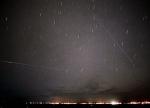 Mir Flares Farewell
23.03.2001
Streaking low across the western horizon after sunset, the Russian Mir space station makes a final pass through the evening sky above the coastal city of Salvador, Brazil. In this 5 minute 20 second time exposure made with ASA 800 film and a wide-angle lens on March 19, setting stars leave short, almost vertical trails.
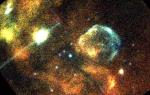 XMM-Newton First Light: X-Rays From The LMC
11.02.2000
Recently the European Space Agency released this and other spectacular "first light" pictures from its new orbiting x-ray observatory, christened XMM-Newton. A churning region of star birth and death in our small neighboring galaxy, the Large Magellanic Cloud (LMC), this field was one of several chosen to test out XMM-Newton's x-ray imaging capabilities.
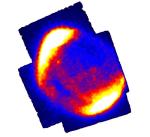 SN 1006: Pieces of the Cosmic Ray Puzzle
2.12.2000
Research balloon flights conducted in 1912 by Austrian physicist Victor Hess revealed that the Earth was constantly bombarded by high energy radiation from space - which came to be called "Cosmic Rays". What are Cosmic Rays and where do they come from?
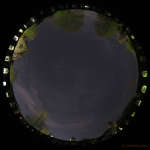 A Spring Sky Over Hirsau Abbey
6.05.2009
What's in the sky tonight? When strolling outside just after sunset, even if just going out to your car, a casual glance upwards can reveal a beautiful night sky also seen by many people across the Earth.
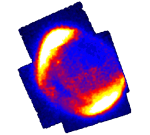 SN 1006: Pieces of the Cosmic Ray Puzzle
16.10.1996
Research balloon flights conducted in 1912 by Austrian physicist Victor Hess revealed that the Earth was constantly bombarded by high energy radiation from space - which came to be called "Cosmic Rays". What are Cosmic Rays and where do they come from?
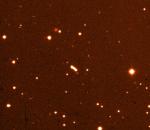 Asteroid 2002 NY40
17.08.2002
Asteroid 2002 NY40 will fly by planet Earth early in the morning August 18 Universal Time (late in the evening August 17 Eastern Daylight Time). Approaching to within about 530,000 kilometers or 1.3 times the Earth-Moon distance 2002 NY40 will definitely not be close enough to pose any danger of collision.
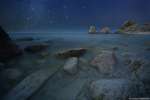 Andromeda on the Rocks
27.09.2013
How far can you see? The Andromeda Galaxy 2.5 million light years away is the most distant object easily seen by the unaided eye. Other apparent denizens of the night sky, stars, clusters...
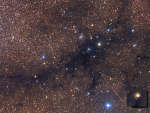 LDN 988: Dark Nebula in Cygnus
19.11.2014
Obscuring the rich starfields of northern Cygnus, dark nebula LDN 988 lies near the center of this cosmic skyscape. Composed with telescope and camera, the scene is some 2 degrees across. That corresponds to 70 light-years at the estimated 2,000 light-year distance of LDN 988.
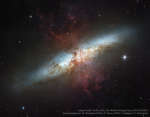 M82: Galaxy with a Supergalactic Wind
21.02.2016
What's lighting up the Cigar Galaxy? M82, as this irregular galaxy is also known, was stirred up by a recent pass near large spiral galaxy M81. This doesn't fully explain the source of the red-glowing outwardly expanding gas, however.
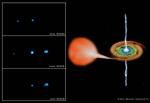 The X Ray Jets of XTE J1550
8.10.2002
The motion of ultra-fast jets shooting out from a candidate black hole star system have now been documented by observations from the orbiting Chandra X-ray Observatory. In 1998, X-ray source XTE J1550-564 underwent a tremendous outburst.
|
January February March April May June July August September October |
|||||||||||||||||||||||||||||||||||||||||||||||||