
|
You entered: Earth
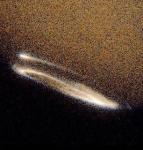 Jovian Aurora
23.01.1998
These two recently released Hubble Space Telescope close-ups show the Northern and Southern lights ... on Jupiter. Like aurora on Earth, these Jovian aurora are caused by charged particles funneled into the atmosphere above the planet's North (right) and South poles by magnetic fields.
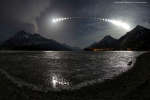 Waterton Lake Eclipse
17.04.2014
Recorded on April 15th, this total lunar eclipse sequence looks south down icy Waterton Lake from the Waterton Lakes National Park in Alberta, Canada, planet Earth. The most distant horizon includes peaks in Glacier National Park, USA.
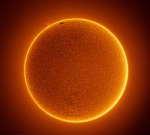 The Space Station Crosses a Spotless Sun
15.07.2019
That's no sunspot. It's the International Space Station (ISS) caught passing in front of the Sun. Sunspots, individually, have a dark central umbra, a lighter surrounding penumbra, and no solar panels. By contrast, the ISS is a complex and multi-spired mechanism, one of the largest and most sophisticated machines ever created by humanity.
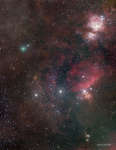 Comet ATLAS and Orion s Belt
12.11.2020
With its closest approach to planet Earth scheduled for November 14, this Comet ATLAS (C/2020 M3) was discovered just this summer, another comet found by the NASA funded Asteroid Terrestrial-impact Last Alert System.
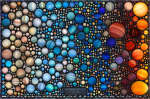 APOD: 2024 July 8 Б Exoplanet Zoo: Other Stars
8.07.2024
Do other stars have planets like our Sun? Surely they do, and evidence includes slight star wobbles created by the gravity of orbiting exoplanets and slight star dimmings caused by orbiting planets moving in front.
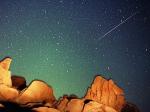 A Perseid Meteor
11.08.2004
The ongoing Perseid Meteor Shower should be at its strongest tonight and tomorrow night. Although meteors should be visible all night long, the best time to watch will be between 2:00 AM and dawn each night. In dark, moonless, predawn skies you may see dozens of meteors per hour.
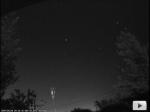 Gigantic Jets Over Oklahoma
29.08.2007
Have you ever seen a gigantic jet? They are extremely rare but tremendously powerful. Gigantic jets are a newly discovered type of lightning discharge between some thunderstorms and the Earth's ionosphere high above them. Pictured above is one such jet caught by accident by a meteor camera in Oklahoma, USA.
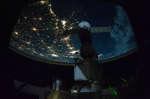 Night Lights
4.11.2010
Constellations of lights sprawl across this night scene, but they don't belong in the skies of planet Earth. Instead, the view looks down from the International Space Station as it passed over the United States along the northern Gulf Coast on October 29. A Russian Soyuz spacecraft is docked in the foreground.
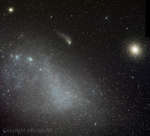 Cloud, Clusters and Comet Siding Spring
4.09.2014
On October 19th, a good place to watch Comet Siding Spring will be from Mars. Then, this inbound visitor (C/2013 A1) to the inner solar system, discovered in January 2013 by Robert McNaught at Australia's Siding Spring Observatory, will pass within 132,000 kilometers of the Red Planet.
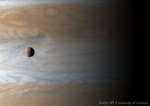 Io: Moon over Jupiter
7.08.2016
How big is Jupiter's moon Io? The most volcanic body in the Solar System, Io (usually pronounced "EYE-oh") is 3,600 kilometers in diameter, about the size of planet Earth's single large natural satellite.
|
January February March April May June July August September October |
|||||||||||||||||||||||||||||||||||||||||||||||||