
|
You entered: space
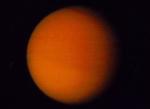 Titan: Saturns Smog Moon
7.02.1999
The largest moon of Saturn is a rare wonder. Titan is the only one of Saturn's moons with an atmosphere, and one of only two moons in the Solar System with this distinction (Neptune's Triton is the other).
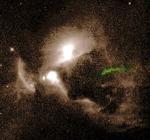 A Disk and Jet in Haro 6-5B
11.02.1999
Planets condense from disks. Several new Hubble Space Telescope pictures of stars surrounded by disks were released earlier this week. Since the glare of the central star usually makes a surrounding disk hard...
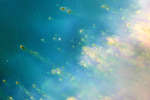 Curious Cometary Knots in the Helix Nebula
13.04.2008
What causes unusual knots of gas and dust in planetary nebulas? Seen also in the Ring Nebula, the Dumbbell Nebula and the Eskimo Nebula, the knots' existence was not initially predicted and their origins are still not well understood.
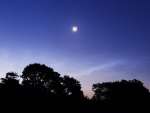 Night Shinings
2.07.2008
In the early morning hours of June 30th, ghostly clouds hovered in the east in this view of near dawn skies over western France. The noctilucent or night-shining clouds lie near the edge of space, reflecting sunlight from about 80 kilometers above Earth's surface.
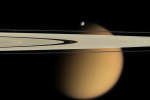 Titan Beyond the Rings
5.05.2009
When orbiting Saturn, be sure to watch for breathtaking superpositions of moons and rings. One such picturesque vista was visible recently to the robot Cassini spacecraft now orbiting Saturn. In 2006 April, Cassini captured Saturn's A and F rings stretching in front of cloud-shrouded Titan.
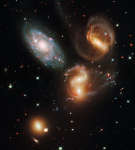 Stephan s Quintet
11.09.2009
The first identified compact galaxy group, Stephan's Quintet is featured in this stunning image from the newly upgraded Hubble Space Telescope. About 300 million light-years away, only four galaxies of the group are actually locked in a cosmic dance of repeated close encounters. The odd man out is easy to spot, though.
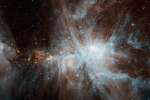 Spitzer s Orion
10.04.2010
Few cosmic vistas excite the imagination like the Orion Nebula, an immense stellar nursery some 1,500 light-years away. Spanning about 40 light-years across the region, this new infrared image from the Spitzer Space...
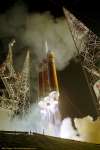 Launch of a Delta IV Heavy
14.12.2010
It is the tallest rocket in active use. The Delta IV Heavy is the largest of the Delta series, packing the punch of three rocket boosters instead of the usual one. The resulting rocket...
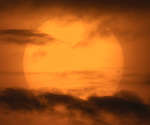 A Picturesque Venus Transit
16.10.2011
The rare transit of Venus across the face of the Sun in 2004 was one of the better-photographed events in sky history. Both scientific and artistic images flooded in from the areas that could see the transit: Europe and much of Asia, Africa, and North America.
 The Eagle and The Swan
31.05.2013
The Eagle Nebula and the Swan Nebula span this broad starscape, a telescopic view of the Sagittarius spiral arm toward the center of our Milky Way galaxy. The Eagle, also known as M16, is left, above center, and the Swan, or M17 at the lower right.
|
January February March April May June July August September |
|||||||||||||||||||||||||||||||||||||||||||||||||