
|
You entered: rings
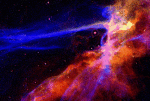 Rampaging Fronts of the Veil Nebula
7.03.1996
A supernova explosion of a high-mass star results in fast moving blast waves. At the front of the waves shown above, ionized gas in the Veil Supernova Remnant rushes out from the explosion, sweeps up material, and breaks up many atoms into constituent ions and electrons.
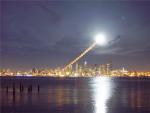 Moonrise Over Seattle
11.10.2003
Is the Moon larger when near the horizon? No -- as shown above, the Moon appears to be very nearly the same size no matter its location on the sky. Oddly, the cause or causes for the common Moon Illusion are still being debated.
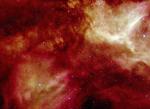 N159 and the Papillon Nebula
21.12.2003
In a search for massive stars, the Hubble Space Telescope has peered into yet another spectacular region of star formation. This nebula, known as N159, spans over 150 light-years and is located in the neighboring Large Magellanic Cloud galaxy, about 170,000 light years distant.
 The Fairy of Eagle Nebula
25.04.2005
The dust sculptures of the Eagle Nebula are evaporating. As powerful starlight whittles away these cool cosmic mountains, the statuesque pillars that remain might be imagined as mythical beasts. Pictured above is one of several striking dust pillars of the Eagle Nebula that might be described as a gigantic alien fairy.
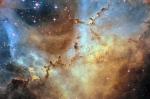 Dust Sculptures in the Rosette Nebula
6.06.2007
What creates the cosmic dust sculptures in the Rosette Nebula? Noted for the common beauty of its overall shape, parts of the Rosette Nebula, also known as NGC 2244, show beauty even when viewed up close.
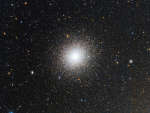 Globular Star Cluster 47 Tuc
24.10.2020
Globular star cluster 47 Tucanae is a jewel of the southern sky. Also known as NGC 104, it roams the halo of our Milky Way Galaxy along with some 200 other globular star clusters.
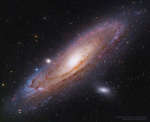 M31: The Andromeda Galaxy
19.01.2022
The most distant object easily visible to the unaided eye is M31, the great Andromeda Galaxy. Even at some two and a half million light-years distant, this immense spiral galaxy -- spanning over 200,000 light years -- is visible, although as a faint, nebulous cloud in the constellation Andromeda.
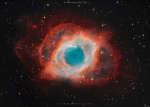 NGC 7293: The Helix Nebula
7.12.2022
A mere seven hundred light years from Earth, toward the constellation Aquarius, a sun-like star is dying. The dying star's last few thousand years have produced the Helix Nebula (NGC 7293), a well studied and nearby example of a Planetary Nebula, typical of this final phase of stellar evolution.
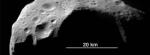 Asteroid 253 Mathilde's Large Craters
1.07.1997
You're zipping through the Solar System when you pass ... asteroid 253 Mathilde. This actually happened to NASA's NEAR spacecraft just last Friday. The above picture of the previously unresolved asteroid was released just yesterday.
 The Solar Wind Emerges
8.02.1999
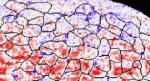
Winds of fast particles blow out from the Sun, but why? Astronomers came a step closer to answering this question recently by making detailed observations of the high-speed wind source with the space-borne Solar and Heliospheric Observatory (SOHO).
|
January February March April May |
|||||||||||||||||||||||||||||||||||||||||||||||||