
|
You entered: nearest stars
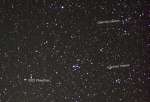 Phaethon s Brood
23.12.2017
Based on its well-measured orbit, 3200 Phaethon (sounds like FAY-eh-thon) is recognized as the source of the meteroid stream responsible for the annual Geminid meteor shower. Even though most meteor showers' parents are comets, 3200 Phaethon is a known and closely tracked near-Earth asteroid with a 1.4 year orbital period.
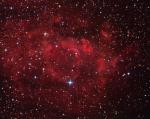 Stars and the Bubble Nebula
17.01.2003
Seemingly adrift in an cosmic sea of stars and gas, this delicate, floating apparition is cataloged as NGC 7635 -- The Bubble Nebula. In this wide-angle view, the Bubble nebula lies at the center of a larger complex of shocked glowing gas about 11,000 light-years distant in the fair constellation Cassiopeia.
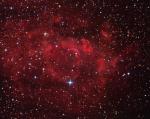 Stars and the Bubble Nebula
28.03.2004
Seemingly adrift in a cosmic sea of stars and gas, this delicate, floating apparition is cataloged as NGC 7635 -- The Bubble Nebula. In this wide-angle view, the Bubble nebula lies at the center of a larger complex of shocked glowing gas about 11,000 light-years distant in the fair constellation Cassiopeia.
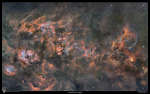 Cygnus Mosaic 2010 2020
11.02.2021
In brush strokes of interstellar dust and glowing gas, this beautiful skyscape is painted across the plane of our Milky Way Galaxy near the northern end of the Great Rift and the constellation Cygnus the Swan.
 Markarian s Chain to Messier 64
24.06.2017
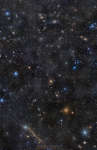
Top to bottom, this colorful and broad telescopic mosaic links Markarian's Chain of galaxies across the core of the Virgo Cluster to dusty spiral galaxy Messier 64. Galaxies are scattered through the field of view that spans some 20 full moons across a gorgeous night sky.
 A View Toward M106
22.02.2024
Big, bright, beautiful spiral, Messier 106 dominates this cosmic vista. The nearly two degree wide telescopic field of view looks toward the well-trained constellation Canes Venatici, near the handle of the Big Dipper. Also...
 APOD: 2020 July 28 Б NGC 6188: The Dragons of Ara
28.07.2020
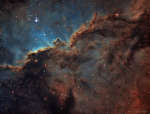
Dark shapes with bright edges winging their way through dusty NGC 6188 are tens of light-years long. The emission nebula is found near the edge of an otherwise dark and large molecular cloud in the southern constellation Ara, about 4,000 light-years away.
 A View Toward M106
1.05.2020
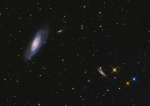
Big, bright, beautiful spiral, Messier 106 dominates this cosmic vista. The nearly two degree wide telescopic field of view looks toward the well-trained constellation Canes Venatici, near the handle of the Big Dipper. Also...
 The Galactic Center in Stars, Gas, and Magnetism
2.06.2021
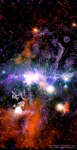
What's going on near the center of our galaxy? To help find out, a newly detailed panorama has been composed that explores regions just above and below the galactic plane in radio and X-ray light.
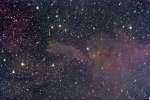 CG4: A Ruptured Cometary Globule
1.09.2008
Can a gas cloud grab a galaxy? It's not even close. The "claw" of this odd looking "creature" in the above photo is a gas cloud known as a cometary globule. This globule, however, has ruptured. Cometary globules are typically characterized by dusty heads and elongated tails.
|
January February March April May June July August September October |
|||||||||||||||||||||||||||||||||||||||||||||||||