
|
You entered: image
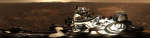 Mars Perseverance Sol 3
26.02.2021
Stitched together on planet Earth, 142 separate images make up this 360 degree panorama from the floor of Jezero Crater on Mars. The high-resolution color images were taken by the Perseverance rover's zoomable Mastcam-Z during mission sol 3, also known as February 21, 2021.
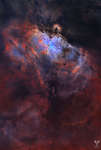 Star Forming Eagle Nebula without Stars
4.10.2022
The whole thing looks like an eagle. A closer look at the Eagle Nebula's center, however, shows the bright region is actually a window into the center of a larger dark shell of dust. Through this window, a brightly-lit workshop appears where a whole open cluster of stars is being formed.
 APOD: 2023 March 14 Б W5: The Soul Nebula
14.03.2023
Stars are forming in the Soul of the Queen of Aethopia. More specifically, a large star forming region called the Soul Nebula can be found in the direction of the constellation Cassiopeia, whom Greek mythology credits as the vain wife of a King who long ago ruled lands surrounding the upper Nile river.
 APOD: 2023 June 19 Б The Busy Center of the Lagoon Nebula
19.06.2023
The center of the Lagoon Nebula is a whirlwind of spectacular star formation. Visible near the image center, at least two long funnel-shaped clouds, each roughly half a light-year long, have been formed by extreme stellar winds and intense energetic starlight. A tremendously bright nearby star, Herschel 36, lights the area.
 APOD: 2025 February 25 Б M41: The Little Beehive Star Cluster
25.02.2025
Why are there so many bright blue stars? Stars are usually born in clusters, and the brightest and most massive of these stars typically glow blue. Less-bright, non-blue stars like our Sun surely also exist in this M41 star cluster but are harder to see. A few bright orange-appearing red giant stars are visible.
 At the Core of M15
20.11.1995
Densely packed stars in the core of the globular cluster M15 are shown in this Hubble Space Telescope (HST) image taken in April of 1994. The stars revealed are contained in an area 1.6 light years across and their colors roughly indicate their temperatures - hot stars appear blue, cooler stars look reddish-orange.
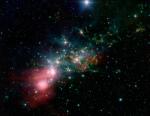 Dusty NGC 1333
24.11.2005
Dusty NGC 1333 is seen as a reflection nebula in visible light images, sporting bluish hues characteristic of starlight reflected by dust. But at longer infrared wavelengths, the interstellar dust itself glows - shown in red in this false-color Spitzer Space Telescope image.
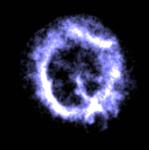 X-ray Hot Supernova Remnant in the SMC
9.12.1999
The Q-shaped cloud seen in this false-color X-ray image from the orbiting Chandra Observatory is big ... about 40 light-years across. It's hot too, as its X-ray glow is produced by multi-million degree gas.
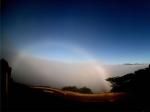 A Fog Bow Over California
15.11.2006
Is that white arch real? What is being seen is a fogbow, a reflection of sunlight by water drops similar to a rainbow but without the colors. The fog itself is not confined to an arch -- the fog is mostly transparent but relatively uniform.
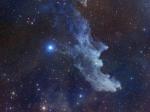 IC 2118: The Witch Head Nebula
11.12.2006
Double, double toil and trouble; Fire burn, and cauldron bubble -- maybe Macbeth should have consulted the Witch Head Nebula. This suggestively shaped reflection nebula is associated with the bright star Rigel in the constellation Orion.
|
January February March April May June July August September |
|||||||||||||||||||||||||||||||||||||||||||||||||