
|
You entered: wind
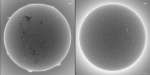 A February without Sunpots
5.03.2019
Where have all the sunspots gone? Last month the total number of spots that crossed our Sun was ... zero. Well below of the long term monthly average, the Sun's surface has become as unusually passive this solar minimum just like it did 11 years ago during the last solar minimum.
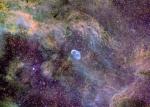 NGC 6888: A Tricolor Starfield
6.07.2006
NGC 6888, also known as the Crescent Nebula, is a cosmic bubble about 25 light-years across, blown by winds from its central, bright, massive star. Near the center of this intriguing widefield view of interstellar gas clouds and rich star fields of the constellation Cygnus, NGC 6888 is about 5,000 light-years away.
 APOD: 2024 October 30 Б NGC 7635: The Bubble Nebula
29.10.2024
What created this huge space bubble? Blown by the wind from a star, this tantalizing, head-like apparition is cataloged as NGC 7635, but known simply as the Bubble Nebula. The featured striking view utilizes a long exposure to reveal the intricate details of this cosmic bubble and its environment.
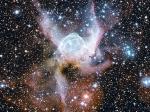 Thors Helmet from CFHT
29.01.2007
NGC 2359 is a striking emission nebula with an impressive popular name - Thor's Helmet Sure, its suggestive winged appearance might lead some to refer to it as the "duck nebula", but if you were a nebula which name would you choose?
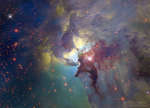 The Lively Center of the Lagoon Nebula
24.05.2022
The center of the Lagoon Nebula is a whirlwind of spectacular star formation. Visible near the image center, at least two long funnel-shaped clouds, each roughly half a light-year long, have been formed by extreme stellar winds and intense energetic starlight. A tremendously bright nearby star, Herschel 36, lights the area.
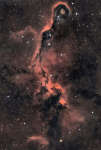 APOD: 2026 August 20 Б The Elephant s Trunk in Cepheus
19.08.2026
Like an illustration in a galactic Just So Story, the Elephant's Trunk Nebula winds through the emission region and young star cluster complex IC 1396, in the high and far off constellation of Cepheus. Also known as vdB 142, this cosmic elephant's trunk is over 20 light-years long.
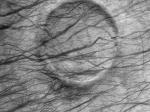 A Dust Devil Crater on Mars
29.12.2003
What caused the streaks in this Martian crater? Since the above image shows streaks occurring both inside and outside the crater, they were surely created after the crater-causing impact. Newly formed trails like these...
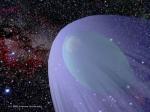 The Suns Heliosphere and Heliopause
24.06.2002
Where does the Sun's influence end? Nobody is sure. Out past the orbits of Neptune and Pluto extends a region named the heliosphere where the Sun's magnetic field and particles from the Solar Wind continue to dominate.
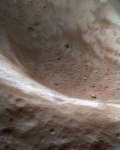 The Regolith of Asteroid Eros
19.06.2011
From fifty kilometers above asteroid Eros, the surface inside one of its largest craters appears covered with an unusual substance: regolith. The thickness and composition of the surface dust that is regolith remains a topic of much research.
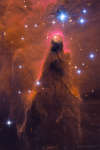 APOD: 2023 January 10 Б NGC 2264: The Cone Nebula
9.01.2023
Stars are forming in the gigantic dust pillar called the Cone Nebula. Cones, pillars, and majestic flowing shapes abound in stellar nurseries where clouds of gas and dust are sculpted by energetic winds from newborn stars. The Cone Nebula, a well-known example, lies within the bright galactic star-forming region NGC 2264.
|
January February March April May June July August September |
|||||||||||||||||||||||||||||||||||||||||||||||||