
|
You entered: time
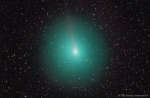 Comet 45P Passes Near the Earth
12.02.2017
A large snowball has just passed the Earth. Known as Comet 45P/HondaMrkosPajduАkovА", or 45P for short, the comet came 10 times closer to Earth yesterday than the Earth ever gets to the Sun. During this passage, the comet was photographed sporting a thin ion tail and a faint but expansive green coma.
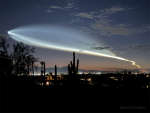 APOD: 2025 October 15 Б Rocket Launch Plume over Tucson
15.10.2025
Yes, but can your sunset do this? Looking west from Tucson, Arizona, USA one day last month, the sunset sky looked strange when it briefly lit up with the plume of a rocket launched from California a few minutes earlier.
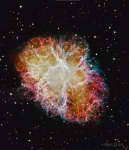 APOD: 2025 December 29 Б M1: The Crab Nebula
29.12.2025
This is the mess that is left when a star explodes. The Crab Nebula, the result of a supernova seen in 1054 AD, is filled with mysterious filaments. The filaments are not only tremendously...
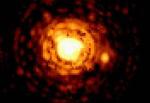 Small Star
5.06.1997
A dim double star system cataloged as Gliese 623 lies 25 light-years from Earth, in the constellation of Hercules. The individual stars of this binary system were distinguished for the first time when the Hubble Space Telescope's Faint Object Camera recorded this image in June 1994.
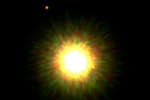 Companion of a Young, Sun-like Star Confirmed
4.07.2010
The first direct image of an extrasolar planet orbiting a star similar to our Sun has been confirmed. Located just 500 light-years away toward the constellation Scorpius, the parent star, cataloged as 1RXS J160929.1-210524, is only slightly less massive and a little cooler than the Sun.
 Approaching Jupiter
26.09.2000
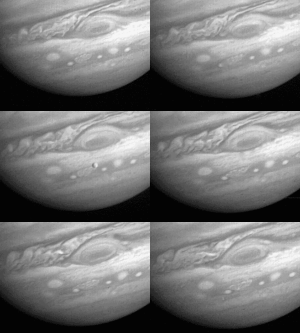
In 1979 the Voyager 1 spacecraft compiled this view as it approached the gas giant Jupiter. Snapping a picture every time the Great Red Spot was properly aligned, the above time-lapse sequence shows not only spot rotation but also the swirling of neighboring clouds.
 Open Star Cluster M38
7.01.2003
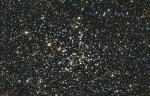
Open cluster M38 can be seen with binoculars toward the constellation of Auriga. M38 is considered an intermediately rich open cluster of stars, each of which is about 200 million years old. Located...
 GRO J1655 40: Evidence for a Spinning Black Hole
8.05.2001
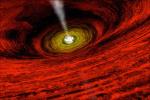
In the center of a swirling whirlpool of hot gas is likely a beast that has never been seen directly: a black hole. Studies of the bright light emitted by the swirling gas frequently indicate not only that a black hole is present, but also likely attributes.
 The Largest Rock Known
1.01.1998
There, that faint dot in the center - that's the largest rock known. It is larger than every known asteroid, moon, and comet nucleus. It is larger than any other rocky planet. (Nobody knows...
 Warped Sky: Star Trails Panorama
13.06.2007
What's happened to the sky? A time warp, of sorts, and a digital space warp too. The time warp occurs because the above image captured in a single frame a four hour exposure of the night sky. Prominent and picturesque star trails are visible.
|
January February March April May June July August September |
|||||||||||||||||||||||||||||||||||||||||||||||||