
|
You entered: star system
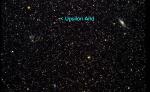 Where is Upsilon Andromedae
22.04.1999
Astronomers recently announced the detection of three large planets orbiting the star Upsilon Andromedae - the first planetary system known to orbit a normal star other than our Sun. These planets were not directly photographed but found through a Doppler technique developed to use large telescopes to search nearby stars for wobbling planetary signatures.
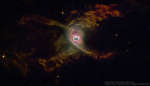 The Red Spider Planetary Nebula
19.04.2017
Oh what a tangled web a planetary nebula can weave. The Red Spider Planetary Nebula shows the complex structure that can result when a normal star ejects its outer gases and becomes a white dwarf star.
 APOD: 2025 July 22 Б A Double Detonation Supernova
22.07.2025
Can some supernovas explode twice? Yes, when the first explosion acts like a detonator for the second. This is a leading hypothesis for the cause of supernova remnant (SNR) 0509-67
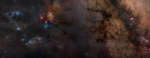 Dark River Wide Field
19.07.2010
A Dark River of dust seems to run from our Galactic Center, then pool into a starfield containing photogenic sky wonders. Scrolling right will reveal many of these objects including (can you find?)...
 The First Image of an Extra Solar Planet
10.05.2005
It's the faint red object, not the bright white one that might be a historic find. The white object is surely a brown dwarf star. Quite possibly, however, the red object is the first direct image of a planet beyond our Solar System.
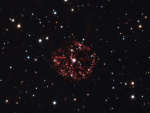 GK Per: Nova of 1901
5.11.2011
Early in the 20th century, GK Persei briefly became one of the brightest stars in planet Earth's sky, an event known as Nova Persei 1901. Documented in this modern day composite of two images from 2003 and 2011 the ejecta from the explosion, popularly called the Firework Nebula, continues to expand into space.
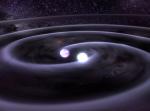 White Dwarf Star Spiral
1.06.2005
About 1,600 light-years away, in a binary star system fondly known as J0806, two dense white dwarf stars orbit each other once every 321 seconds. Interpreting x-ray data from the Chandra Observatory astronomers argue that the stars' already impressively short orbital period is steadily getting shorter as the stars spiral closer together.
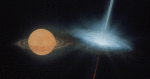 Jets From SS433
6.03.1996
SS433 is one of the most exotic star systems known to astronomers. Its unremarkable name stems from its inclusion in a catalog of stars which emit radiation characteristic of atomic hydrogen. Its very remarkable behavior stems from a compact object, a black hole or neutron star, which has produced an accretion disk with jets.
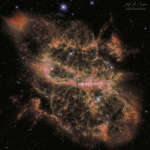 APOD: 2020 August 14 Б NGC 5189: An Unusually Complex Planetary Nebula
14.08.2020
Why is this nebula so complex? When a star like our Sun is dying, it will cast off its outer layers, usually into a simple overall shape. Sometimes this shape is a sphere, sometimes a double lobe, and sometimes a ring or a helix.
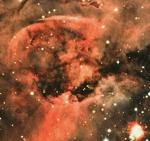 In the Center of the Keyhole Nebula
21.07.1997
Stars, like people, do not always go gentle into that good night. The above Keyhole Nebula results from dying star Eta Carinae's violently casting off dust and gas during its final centuries. Eta Carinae is many times more massive than our own Sun, and should eventually undergo a tremendous supernova explosion.
|
January February March April May June July August September |
|||||||||||||||||||||||||||||||||||||||||||||||||