
|
You entered: impact
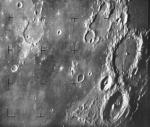 Moon Crashers
15.10.1999
On July 31, 1964, Ranger 7 crashed into the Moon. Seventeen minutes before impact it snapped this picture - the first image of the Moon ever taken by a U.S. spacecraft. Of course Ranger 7 was intended to crash, transmitting close-up pictures of the lunar surface during its final moments.
 APOD: 2025 July 17 Б 3I/ATLAS
17.07.2025
Discovered on July 1 with the NASA-funded ATLAS (Asteroid Terrestrial-impact Last Alert, System) survey telescope in Rio Hurtado, Chile, 3I/ATLAS is so designated as the third known interstellar object to pass through our Solar System It follows 1I/йOumuamua in 2017 and the comet 2I/Borisov in 2019.
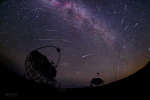 Gamma rays and Comet Dust
20.08.2016
Gamma-rays and dust from periodic Comet Swift-Tuttle plowed through planet Earth's atmosphere on the night of August 11/12. Impacting at about 60 kilometers per second the grains of comet dust produced this year's remarkably active Perseid meteor shower.
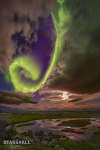 Spiral Aurora over Icelandic Divide
21.04.2019
Admire the beauty but fear the beast. The beauty is the aurora overhead, here taking the form of great green spiral, seen between picturesque clouds with the bright Moon to the side and stars in the background. The beast is the wave of charged particles that creates the aurora but might, one day, impair civilization.
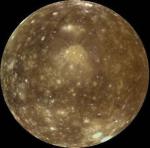 Callisto in True Color
11.05.1998
Callisto's surface has many stories to tell. The most distant of Jupiter's Galilean Moons, Callisto shows the highest density of impact craters in the Solar System, but harbors no volcanoes or even any large mountains. Callisto's surface is laced with cracks and craters from
 Mercury's Faults
21.01.1996
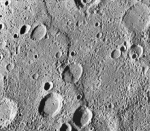
The surface of the planet Mercury is not without fault. In this case, however, "fault" refers to unusual surface features that are the topic of much speculation. The above fault line is called Santa Maria Rupes, and runs through many prominent craters.
 560 Kilometers Above Europa
3.03.1998
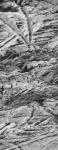
This is the closest photograph ever taken of Europa. Last December, NASA's spacecraft Galileo swept past the Jovian moon and took photographs which were released yesterday. Speculation that life-bearing oceans exist beneath Europa's surface caused NASA to put Galileo on orbits that approach Europa.
 A Flyby View of Ganymede
25.10.1996
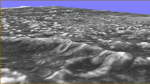
This is what it would look like to fly over the surface of Jupiter's moon Ganymede. NASA's robot spacecraft Galileo recently approached only 6000 miles from this frozen ice-ball of a moon. The above image is a digital reconstruction from two images taken during this flyby.
 The Cartwheel Galaxy
2.07.1995
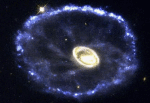
The Cartwheel Galaxy shows a ring that is the result of a collision between a small and a large galaxy. After a small galaxy has moved through a big galaxy - in this case...
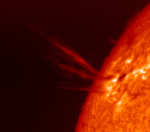 A Solar Corona Ejection
8.11.1996
The Sun would not be a nice place to spend the summer. One reason, besides the extreme heat, is that explosions are common there. In the above picture, magnetic fields buckle releasing previously constrained hot material from the upper atmosphere of the Sun.
|
January February |
|||||||||||||||||||||||||||||||||||||||||||||||||