
|
You entered: image
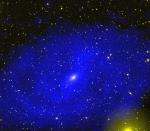 Ghost Galaxy NGC 2915
15.07.1998
How do you find a nearly invisible galaxy? Pictured above is the blue compact dwarf (BCD) galaxy NGC 2915. In visible light, shown above in yellow, this galaxy appears to be a normal dwarf galaxy, as indicated by the yellow smudge in the image center.
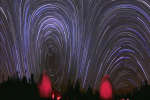 Warped Sky: Star Trails Panorama
11.07.2010
What's happened to the sky? A time warp, of sorts, and a digital space warp too. The time warp occurs because this image captured in a single frame a four hour exposure of the night sky. As a result, prominent star trails are visible.
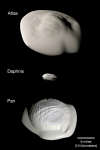 Atlas, Daphnis, and Pan
6.07.2017
Atlas, Daphnis, and Pan are small, inner, ring moons of Saturn, shown at the same scale in this montage of images from the still Saturn-orbiting Cassini spacecraft. In fact, Daphnis was discovered in Cassini images from 2005. Atlas and Pan were first sighted in images from the Voyager 1 and 2 spacecraft.
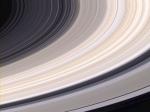 Saturns Rings in Natural Color
23.07.2004
What colors are Saturn's rings? Recent images from the Cassini spacecraft now orbiting Saturn confirm that different rings have slightly different colors. The above image shows their sometimes-subtle differences in brightness and color. The rings reflect sunlight and so, even if they were perfectly reflecting, would appear the color of the Sun.
 Earth and Moon from Saturn
22.07.2013
You are here. Everyone you've ever known is here. Every human who has ever lived -- is here. Pictured above is the Earth-Moon system as captured by the Cassini mission orbiting Saturn in the outer Solar System.
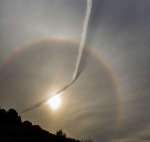 Plane Contrail and Sun Halo
4.04.2017
What's happened to the sky? Several common features of the daytime sky are interacting in uncommon ways. First, well behind the silhouetted hills, is the typically bright Sun. In front...
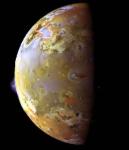 Io: The Prometheus Plume
22.06.2002
Two sulfurous eruptions are visible on Jupiter's volcanic moon Io in this color composite Galileo image. On the left, over Io's limb, a new bluish plume rises about 86 miles above the surface of a volcanic caldera known as Pillan Patera.
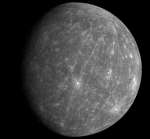 Mercury as Revealed by MESSENGER
8.10.2008
The planet Mercury has been known since history has been recorded, but parts of the Solar System's innermost planet have never been seen like this before. Two days ago the robotic MESSENGER spacecraft buzzed past Mercury for the second time and imaged terrain mapped previously only by comparatively crude radar.
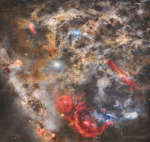 APOD: 2026 March 2 Б The Dusty Surroundings of Orion and the Pleiades
2.03.2026
How well do you know the night sky? OK, but how well can you identify famous sky objects in a very deep image? Either way, here is a test: see if you can find some well-known night-sky icons in a deep image filled with filaments of normally faint dust and gas.
 Ring Around the Cluster
4.01.1999
It is difficult to hide a galaxy behind a cluster of galaxies. The closer cluster's gravity will act like a huge lens, pulling images of the distant galaxy around the sides and greatly distorting them. This is just the case observed in the above recently released image from the VLT.
|
January February March April May June July August September |
|||||||||||||||||||||||||||||||||||||||||||||||||