
|
You entered: hot gas
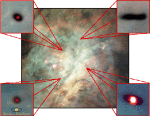 Planetary Systems Now Forming in Orion
7.12.1996
How do planets form? Astronomers are finding out by studying one of the most interesting of all astronomical nebulae known, the Great Nebula in Orion. Insets to above mosaic show several planetary systems in formation. The bottom left insert shows the relative size of our own Solar System. The Orion Nebula contains many stellar nurseries.
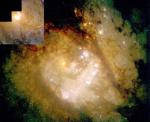 In the Center of Spiral Galaxy M83
6.11.2001
What's happening at the center of spiral galaxy M83? Just about everything, from the looks of it. M83, visible in the inset image on the upper left, is one of the closest spiral galaxies to our own Milky Way Galaxy and from a distance of 15 million light-years, appears to be relatively normal.
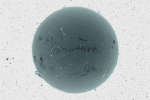 Black Sun and Inverted Starfield
15.10.2012
Does this strange dark ball look somehow familiar? If so, that might be because it is our Sun. In the above image, a detailed solar view was captured originally in a very specific color of red light, then rendered in black and white, and then color inverted.
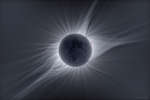 The Big Corona
20.09.2017
Most photographs don't adequately portray the magnificence of the Sun's corona. Seeing the corona first-hand during a total solar eclipse is unparalleled. The human eye can adapt to see coronal features and extent that average cameras usually cannot. Welcome, however, to the digital age.
 Mercury And The Sun
19.11.1999
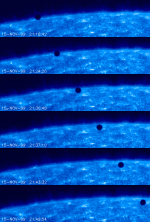
Just days before the peak of the Leonid meteor shower, skywatchers were offered another astronomical treat as planet Mercury crossed the face of the Sun on November 15. Viewed from planet Earth, a transit of Mercury is not all that rare. The last occurred in 1993 and the next will happen in 2003.
 The Great Orion Nebula M42
4.11.2015
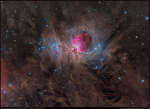
The Great Nebula in Orion, also known as M42, is one of the most famous nebulas in the sky. The star forming region's glowing gas clouds and hot young stars are on the right in this sharp and colorful image that includes the bluish reflection nebulae NGC 1977 and friends on the left.
 A Black Hole in M87's Center?
5.03.1996
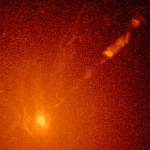
The center of nearby giant galaxy M87 is a dense and violent place. In this 1994 photograph by the Hubble Space Telescope, a disk of hot gas was found to be orbiting at the center of this massive elliptical galaxy. The disk is evident on the lower left of the above photograph.
 In the Vicinity of the Cone Nebula
12.05.2003
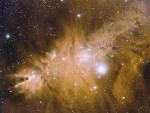
Strange shapes and textures can be found in neighborhood of the Cone Nebula. The unusual shapes originate from fine interstellar dust reacting in complex ways with the energetic light and hot gas being expelled by the young stars.
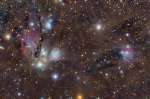 NGC 2170: Celestial Still Life
14.01.2013
In this celestial still life composed with a cosmic brush, dusty nebula NGC 2170 shines left of image center. Reflecting the light of nearby hot stars, NGC 2170 is joined by other bluish reflection nebulae, a red emission region, many dark absorption nebulae, and a backdrop of colorful stars.
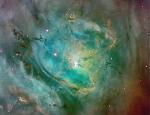 Stars and Dust of the Lagoon Nebula
8.09.2003
The large majestic Lagoon Nebula is home for many young stars and hot gas. Spanning 100 light years across while lying only about 5000 light years distant, the Lagoon Nebulae is so big and bright that it can be seen without a telescope toward the constellation of Sagittarius.
|
January February March April May June July August September |
|||||||||||||||||||||||||||||||||||||||||||||||||