
|
You entered: comet tail
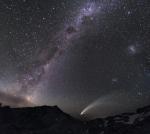 Three Galaxies and a Comet
30.03.2007
Diffuse starlight and dark nebulae along the southern Milky Way arc over the horizon and sprawl diagonally through this gorgeous nightscape. The breath-taking mosaic spans a wide 100 degrees, with the rugged terrain of the Patagonia, Argentina region in the foreground.
 Three Galaxies and a Comet
14.01.2018
Diffuse starlight and dark nebulae along the southern Milky Way arc over the horizon and sprawl diagonally through this gorgeous nightscape. The breath-taking mosaic spans a wide 100 degrees, with the rugged terrain of the Patagonia, Argentina region in the foreground.
 Three Galaxies and a Comet
20.10.2013
Diffuse starlight and dark nebulae along the southern Milky Way arc over the horizon and sprawl diagonally through this gorgeous nightscape. The breath-taking mosaic spans a wide 100 degrees, with the rugged terrain of the Patagonia, Argentina region in the foreground.
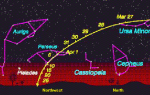 Comet Hyakutake Finder Chart for Early April
31.03.1996
During April Comet Hyakutake heads in toward the Sun after passing the Earth. At this time the comet's orbit places it north of the Earth. Remaining visible in the northern sky as it nears the Sun, it will set progressively earlier in the evening.
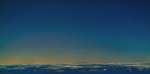 Comet ISON Rising
27.11.2013
Will Comet ISON survive tomorrow's close encounter with the Sun? Approaching to within a solar diameter of the Sun's surface, the fate of one of the most unusual comets of modern times will finally be determined.
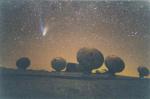 Hale-Bopp and the Plateau de Bure Interferometer
15.04.1997
Comet Hale-Bopp is being observed by many different telescopes. Here the comet is pictured behind the array of radio telescopes which compose the Plateau de Bure Interferometer. These telescopes are being used to detect the presence of different molecules in the coma and tail of Comet Hale-Bopp.
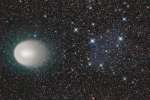 Amazing Comet Holmes
24.10.2008
One year ago, Comet 17P/Holmes amazed sky watchers across planet Earth. A stunningly rapid outburst transformed it from a faint comet quietly orbiting the Sun with a period of about 7 years to a naked-eye comet rivaling the brighter stars in the constellation Perseus.
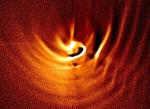 Hale-Bopp's Hoods
14.04.1997
Comet Hale-Bopp is spinning. The nucleus of the comet is a dirty snowball about 25 miles in diameter that spins about once every 12 hours. As Comet Hale-Bopp spins, parts of the comet's surface shoot away in jets.
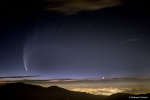 Comet McNaught Over Chile
20.01.2008
Comet McNaught was perhaps the most photogenic comet of our time. After making quite a show in the northern hemisphere in early January, the comet moved south and developed a long and unusual dust tail that dazzled southern hemisphere observers. In this image, Comet McNaught was captured one year ago above Chile.
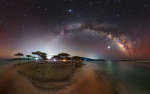 Light and Glory over Crete
16.11.2020
The month was July, the place was the Greek island of Crete, and the sky was spectacular. Of course there were the usual stars like Polaris, Vega, and Antares -- and that common asterism everyone knows: the Big Dipper. But this sky was just getting started.
|
January February March April May June July August September |
|||||||||||||||||||||||||||||||||||||||||||||||||