
|
You entered: X-ray source
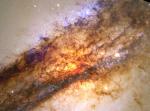 The Center of Centaurus A
17.07.2005
A fantastic jumble of young blue star clusters, gigantic glowing gas clouds, and imposing dark dust lanes surrounds the central region of the active galaxy Centaurus A. This mosaic of Hubble Space Telescope images taken in blue, green, and red light has been processed to present a natural color picture of this cosmic maelstrom.
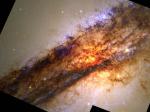 The Center of Centaurus A
29.07.2007
A fantastic jumble of young blue star clusters, gigantic glowing gas clouds, and imposing dark dust lanes surrounds the central region of the active galaxy Centaurus A. This mosaic of Hubble Space Telescope images taken in blue, green, and red light has been processed to present a natural color picture of this cosmic maelstrom.
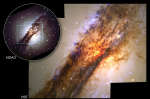 The Center of Centaurus A
7.11.2010
A fantastic jumble of young blue star clusters, gigantic glowing gas clouds, and imposing dark dust lanes surrounds the central region of the active galaxy Centaurus A. This mosaic of Hubble Space Telescope images taken in blue, green, and red light has been processed to present a natural color picture of this cosmic maelstrom.
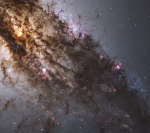 Across the Center of Centaurus A
29.11.2011
A fantastic jumble of young blue star clusters, gigantic glowing gas clouds, and imposing dark dust lanes surrounds the central region of the active galaxy Centaurus A. This image from the Hubble Space Telescope has been processed to present a natural color picture of this cosmic maelstrom.
 APOD: 2025 September 3 Б Cir X1: Jets in the Africa Nebula
3.09.2025
How soon do jets form when a supernova gives birth to a neutron star? The Africa Nebula provides clues. This supernova remnant surrounds Circinus X-1, an X-ray emitting neutron star and the companion star it orbits.
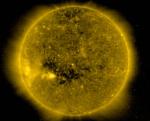 Hole in the Sun
27.09.2007
The dark expanse below the equator of the Sun is a coronal hole -- a low density region extending above the surface where the solar magnetic field opens freely into interplanetary space. Shown in false color, the picture was recorded on September 19th in extreme ultraviolet light by the EIT instrument onboard the space-based SOHO observatory.
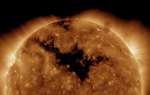 Hole in the Sun
28.08.2010
This ominous, dark shape sprawling across the face of the Sun is a coronal hole -- a low density region extending above the surface where the solar magnetic field opens freely into interplanetary space. Studied...
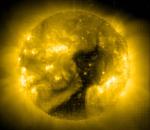 Coronal Hole
7.02.2002
This ominous, dark shape sprawling across the face of the active Sun is a coronal hole -- a low density region extending above the surface where the solar magnetic field opens freely into interplanetary space.
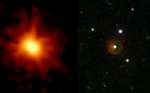 Across the Universe
28.03.2008
How far can you see? Even the faintest stars visible to the eye are merely hundreds or thousands of light-years distant, all well within our own Milky Way Galaxy. Of course, if you know where to look you can also spot the Andromeda Galaxy as a pale, fuzzy cloud, around 2.5 million light-years away.
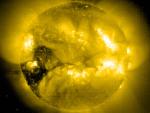 Coronal Holes on the Sun
18.03.2003
The ominous, dark shapes haunting the left side of the Sun are coronal holes -- low density regions extending above the surface where the solar magnetic field opens freely into interplanetary space. Studied extensively from...
|
January February March April May June July August September October |
|||||||||||||||||||||||||||||||||||||||||||||||||