
|
You entered: sky
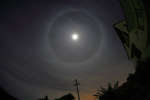 A Halo Around the Moon
20.11.2012
Have you ever seen a halo around the Moon? This fairly common sight occurs when high thin clouds containing millions of tiny ice crystals cover much of the sky. Each ice crystal acts like a miniature lens.
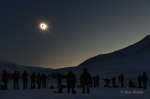 Northern Equinox Eclipse
20.03.2015
Snowy and cold is weather you might expect at the start of spring for Longyearbyen on the Arctic archipelago of Svalbard, Norway. But that turned out to be good weather for watching the Moon's umbral shadow race across northern planet Earth.
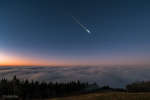 Good Morning Leonid
23.11.2018
On November 17, just an hour before sunrise, this bright and colorful meteor flashed through clear predawn skies. Above a sea of clouds this striking autumn morning's moment was captured from Hochblauen, a prominent 1165 meter high summit in southern Germany's Black Forest.
 Sunset to Sunrise over the Baltic Sea
16.06.2023
This serene view from the coast of Sweden looks across the Baltic sea and compresses time, presenting the passage of one night in a single photograph. From sunset to sunrise, moonlight illuminates the creative sea and skyscape. Fleeting clouds, fixed stars, and flowing northern lights leave their traces in planet Earth's sky.
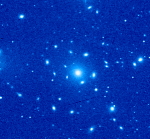 Thousands of Coma Cluster Galaxies
17.09.1995
Almost every object in the above photograph is a galaxy. The Coma Cluster of galaxies pictured is a dense cluster containing many thousands of galaxies. Many of these galaxies contain as many stars as our own Milky Way Galaxy.
 East of Antares
23.06.2006
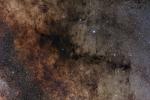
East of Antares, dark markings seem to sprawl through the crowded star fields toward the center of our Milky Way Galaxy. Cataloged in the early 20th century by astronomer E. E. Barnard, the obscuring interstellar dust clouds include B72, B77, B78, and B59, seen in silhouette against the starry background.
 Maria Mitchell Inspires a Generation
16.10.1999
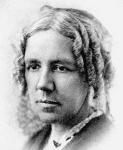
"Do not look at stars as bright spots only - try to take in the vastness of the universe." On October 1, 1847 Maria Mitchell swept the sky with her telescope and discovered a comet (comet Mitchell 1847VI).
 Equinox and Eruptive Prominence
23.09.1999
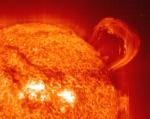
Today, the Sun crosses the celestial equator and seasons change from Summer to Fall in the north and Winter to Spring in the southern hemisphere. Defined by the Sun's position in sky the event is known as an equinox - the length of daylight is equal to the length of night.
 Eclipse Over The Mountain
2.09.1999
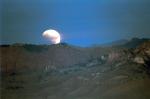
Undaunted by world wide anticipation of the August 11 total solar eclipse, the moon also performed a lunar eclipse just two weeks earlier, on July 28. Crossing the edge of Earth's shadow the moon was only partially eclipsed - but the spectacle could be seen by observers located across the Earth's night side.
 Discovery s Rainbow
2.09.2009
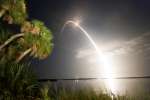
Just one minute before midnight EDT, Friday, August 28, the Space Shuttle Discovery began a long arc into a cloudy sky. Following the launch, a bright and remarkably colorful trail was captured in this time exposure from the Banana River Viewing Site, looking east toward pad 39A at the Kennedy Space Center.
|
January February March April May June July August September October |
|||||||||||||||||||||||||||||||||||||||||||||||||