
|
You entered: color
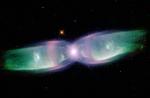 M2 9: Wings of a Butterfly Nebula
12.06.2005
Are stars better appreciated for their art after they die? Actually, stars usually create their most artistic displays as they die. In the case of low-mass stars like our Sun and M2-9 pictured above, the stars transform themselves from normal stars to white dwarfs by casting off their outer gaseous envelopes.
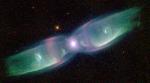 M2 9: Wings of a Butterfly Nebula
21.03.1999
Are stars better appreciated for their art after they die? Actually, stars usually create their most artistic displays as they die. In the case of low-mass stars like our Sun and M2-9 pictured above, the stars transform themselves from normal stars to white dwarfs by casting off their outer gaseous envelopes.
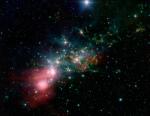 Dusty NGC 1333
24.11.2005
Dusty NGC 1333 is seen as a reflection nebula in visible light images, sporting bluish hues characteristic of starlight reflected by dust. But at longer infrared wavelengths, the interstellar dust itself glows - shown in red in this false-color Spitzer Space Telescope image.
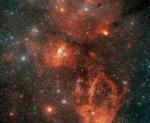 NGC 7635: Bubble in a Cosmic Sea
28.04.2006
Seemingly adrift in a cosmic sea of stars and glowing gas, the delicate, floating apparition near the center (next to a blue tinted star) of this widefield view is cataloged as NGC 7635 - The Bubble Nebula.
 Saturn s Infrared Glow
12.10.2006
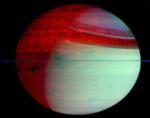
Known for its bright ring system and many moons, gas giant Saturn looks strange and unfamiliar in this false-color view from the Cassini spacecraft. In fact, in this Visual and Infrared Mapping Spectrometer (VIMS) mosaic the famous rings are almost invisible, seen edge-on cutting across picture center.
 X-ray Hot Supernova Remnant in the SMC
9.12.1999
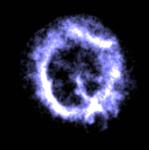
The Q-shaped cloud seen in this false-color X-ray image from the orbiting Chandra Observatory is big ... about 40 light-years across. It's hot too, as its X-ray glow is produced by multi-million degree gas.
 Messier 96
15.06.2007
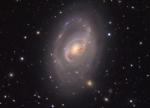
Dust lanes seem to swirl around the core of Messier 96 in this colorful, detailed portrait of the beautiful island universe. Of course M96 is a spiral galaxy, and counting the faint arms extending beyond the brighter central region it spans 100 thousand light-years or so, about the size of our own Milky Way.
 3D Barringer Meteorite Crater
23.06.2007
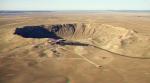
Baringer Meteorite Crater, near Winslow, Arizona, is one of the best known impact craters on planet Earth. View this color stereo anaglyph with red/blue glasses to get a dramatic sense of the crater's dimensions -- one mile wide, and up to 570 feet deep.
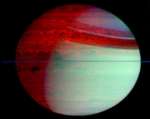 Saturn s Infrared Glow
29.12.2007
(xxxedit and linkxxx) Known for its bright ring system and many moons, gas giant Saturn looks strange and unfamiliar in this false-color view from the Cassini spacecraft. In fact, in this Visual and Infrared Mapping Spectrometer (VIMS) mosaic the famous rings are almost invisible, seen edge-on cutting across picture center.
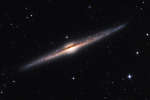 NGC 4565: Galaxy on the Edge
28.04.2009
Is our Galaxy this thin? We believe so. Magnificent spiral galaxy NGC 4565 is likely similar to our own spiral galaxy, but viewed edge-on from far away. Also known as the Needle Galaxy...
|
January February |
|||||||||||||||||||||||||||||||||||||||||||||||||