
|
You entered: nearest stars
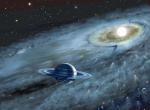 Fomalhaut Dust Disk Indicates Planets
11.10.2002
One of the brightest stars on the sky likely has planets. Fomalhaut, actually the 17th brightest star in the night sky, is a mere 22 light-years away but only a fraction of the age of our Sun.
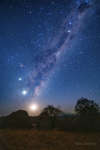 Moon, Four Planets, and Emu
8.02.2019
A luminous Milky Way falls toward the horizon in this deep skyscape, starting at the top of the frame from the stars of the Southern Cross and the dark Coalsack Nebula. Captured...
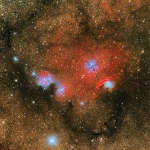 NGC 6559: East of the Lagoon
7.10.2021
Slide your telescope just east of the Lagoon Nebula to find this alluring field of view in the rich starfields of the constellation Sagittarius toward the central Milky Way. Of course the Lagoon nebula is also known as M8, the eighth object listed in Charles Messier's famous catalog of bright nebulae and star clusters.
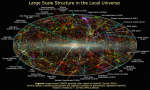 The Universe Nearby
11.12.2007
What does the universe nearby look like? This plot shows over one and a half million of the brightest stars and galaxies in the nearby universe detected by the Two Micron All Sky Survey (2MASS) in infrared light.
 Comet Hale-Bopp Outbound
10.09.1997
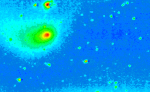
Hale-Bopp, the Comet of the Century, is leaving the inner Solar System. Outbound at about 12 miles per second it is presently nearing the main asteroid belt between Mars and Jupiter. This false-color image represents a recent view from low Earth orbit showing the comet surrounded by its shrinking coma against a background of stars.
 Doomed Star Eta Carinae
16.08.1998
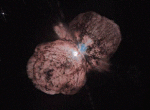
Eta Carinae may be about to explode. But no one knows when - it may be next year, it may be one million years from now. Eta Carinae's mass - about 100 times greater than our Sun - makes it an excellent candidate for a full blown supernova.
 APOD: 2025 August 8 Б Dawn of the Crab
8.08.2025
One of the all-time historic skyscapes occured in July 1054, when the Crab Supernova blazed into the dawn sky. Chinese court astrologers first saw the Guest Star on the morning of 4 July 1054 next to the star Tianguan (now cataloged as Zeta Tauri).
 Doomed Star Eta Carinae
13.08.2000
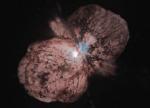
Eta Carinae may be about to explode. But no one knows when - it may be next year, it may be one million years from now. Eta Carinae's mass - about 100 times greater than our Sun - makes it an excellent candidate for a full blown su
 Doomed Star Eta Carinae
28.04.2002
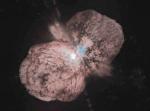
Eta Carinae may be about to explode. But no one knows when - it may be next year, it may be one million years from now. Eta Carinae's mass - about 100 times greater than our Sun - makes it an excellent candidate for a full blown supernova.
 Doomed Star Eta Carinae
28.11.2004
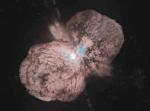
Eta Carinae may be about to explode. But no one knows when - it may be next year, it may be one million years from now. Eta Carinae's mass - about 100 times greater than our Sun - makes it an excellent candidate for a full blown supernova.
|
January February March April May June July August September October |
|||||||||||||||||||||||||||||||||||||||||||||||||