
|
You entered: image
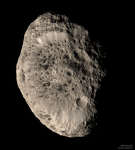 Saturns Hyperion in Natural Color
14.05.2018
What lies at the bottom of Hyperion's strange craters? To help find out, the robot Cassini spacecraft now orbiting Saturn swooped past the sponge-textured moon in 2005 and 2010 and took images of unprecedented detail.
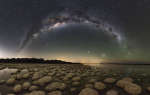 Ancients of Sea and Sky
19.06.2018
They may look like round rocks, but they're alive. Moreover, they are modern versions of one of the oldest known forms of life: stromatolites. Fossils indicate that stromatolites appeared on Earth about 3.7 billion years ago -- even before many of the familiar stars in the modern night sky were formed.
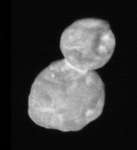 Ultima and Thule
3.01.2019
On January 1 New Horizons encountered the Kuiper Belt object nicknamed Ultima Thule. Some 6.5 billion kilometers from the Sun, Ultima Thule is the most distant world ever explored by a spacecraft from Earth.
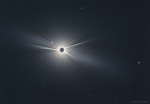 Wide Field View of Great American Eclipse
30.01.2019
Only in the fleeting darkness of a total solar eclipse is the light of the solar corona easily visible. Normally overwhelmed by the bright solar disk, the expansive corona, the sun's outer atmosphere, is an alluring sight.
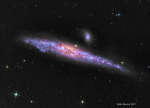 NGC 4631: The Whale Galaxy
6.10.2022
NGC 4631 is a big beautiful spiral galaxy. Seen edge-on, it lies only 25 million light-years away in the well-trained northern constellation Canes Venatici. The galaxy's slightly distorted wedge shape suggests to some a cosmic herring and to others its popular moniker, The Whale Galaxy.
 APOD: 2024 May 29 Б Stairway to the Milky Way
29.05.2024
What happens if you ascend this stairway to the Milky Way? Before answering that, let's understand the beautiful sky you will see. Most eye-catching is the grand arch of the Milky Way Galaxy...
 APOD: 2025 September 16 Б New Comet SWAN25B over Mexico
16.09.2025
A newly discovered comet is already visible with binoculars. The comet, C/2025 R2 (SWAN) and nicknamed SWAN25B, is brightening significantly as it emerges from the Sun's direction and might soon become visible on your smartphone -- if not your eyes.
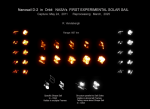 NanoSail D2
2.01.2026
In 2011, on January 20, NASA's NanoSail-D2 unfurled a very thin and very reflective 10 square meter sail becoming the first solar sail spacecraft in low Earth orbit. Often considered the stuff...
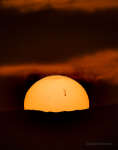 APOD: 2026 February 8 Б Active Sunspot Region 4366 Crosses the Sun
8.02.2026
An unusually active sunspot region is now crossing the Sun. The region, labelled AR 4366, is much larger than the Earth and has produced several powerful solar flares over the past ten days. In the featured image, the region is marked by large and dark sunspots toward the upper right of the Sun's disk.
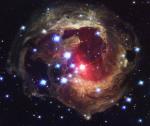 V838 Mon: Light Echo Update
4.02.2005
Expanding light echoes continue to illuminate the dusty environs of V838 Monocerotis, mysterious variable star near the edge of our Galaxy. This stunning image, produced from Hubble data recorded in October of 2004, adds to a unique series of space-based, high-resolution views.
|
January February March April May June July August September |
|||||||||||||||||||||||||||||||||||||||||||||||||