
|
You entered: nearest stars
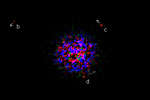 HR 8799: Discovery of a Multi planet Star System
17.11.2008
How common are planetary systems like our own Solar System? In the twelve years previous to 2008, over 300 candidate planetary systems have been found orbiting nearby stars. None, however, were directly imaged, few showed evidence for multiple planets, and many had a Jupiter-sized planet orbiting inside the orbit of Mercury.
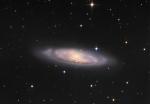 Messier 65
1.06.2007
M65 is a big, beautiful spiral galaxy, the sixty-fifth object in the famous astronomical catalog compiled by 18th century cosmic tourist Charles Messier. It's also a member of a picturesque trio of large spiral galaxies known as the Leo Triplet, about 35 million light-years away.
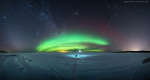 A Symphony in Northern Winter Skies
22.03.2019
Despite the cold, a chance to view the shimmering northern lights coaxed this skygazer onto the frozen surface of Lake Superior on the west coast of the Keweenaw Peninusla and offered this nocturnal crescendo as a reward.
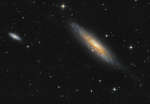 Sculptor Galaxy NGC 134
4.03.2016
NGC 134 is probably not the best known spiral galaxy in the constellation Sculptor. Still, the tantalizing island universe is a clearly a telescopic treasure in southern skies. It shares a bright core, clumpy...
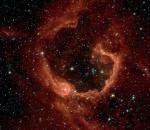 RCW 79: Stars in a Bubble
15.04.2005
A cosmic bubble of gas and dust, RCW 79 has grown to about 70 light-years in diameter, blown by the winds and radiation from hot young stars. Infrared light from the dust embedded in the nebula is tinted red in this gorgeous false-color view from the Spitzer Space Telescope.
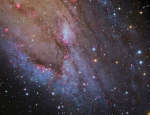 NGC 206 and the Star Clouds of Andromeda
25.09.2014
The large stellar association cataloged as NGC 206 is nestled within the dusty arms of the neighboring Andromeda galaxy. Also known as M31, the spiral galaxy is a mere 2.5 million light-years away.
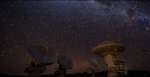 An ALMA Telescope Array Time Lapse
26.05.2014
It is the most expensive and complex ground-based astronomy project ever -- what will it see tonight? The Atacama Large Millimeter Array (ALMA) project consists of 66 dishes, many the size of a small house, situated in the high altitude Atacama Desert in Northern Chile.
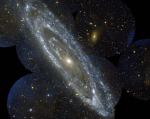 The Andromeda Galaxy from GALEX
22.12.2003
Why does the Andromeda Galaxy have a giant ring? Viewed in ultraviolet light, the closet major galaxy to our Milky Way Galaxy looks more like a ring galaxy than a spiral. The ring...
 Counting Falling Stardust
23.11.2001
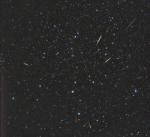
In the clear, dark and moonless predawn hours of November 18, Greenbelt, Maryland's local baseball field was packed. The crowd stared skyward and occasionally conversed in hushed and reverent tones. "How many did you count?" a man asked.
 NGC 7293: The Helix Nebula
3.08.2007
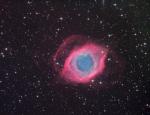
A mere seven hundred light years from Earth, in the constellation Aquarius, a sun-like star is dying. Its last few thousand years have produced the Helix Nebula (NGC 7293), a well studied and nearby example of a Planetary Nebula, typical of this final phase of stellar evolution.
|
January February March April May June July August September October |
|||||||||||||||||||||||||||||||||||||||||||||||||