
|
You entered: nebula
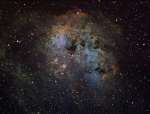 IC 410 and NGC 1893
16.01.2009
Dusty emission nebula IC 410 lies about 12,000 light-years away in the northern constellation Auriga. The cloud of glowing gas is over 100 light-years across, sculpted by stellar winds and radiation from embedded open star cluster NGC 1893.
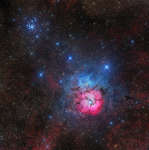 Messier 20 and 21
29.12.2019
The beautiful Trifid Nebula, also known as Messier 20, is easy to find with a small telescope in the nebula rich constellation Sagittarius. About 5,000 light-years away, the colorful study in cosmic contrasts shares this well-composed, nearly 1 degree wide field with open star cluster Messier 21 (top left).
 APOD: 2024 January 31 Б Camera Orion Rising
30.01.2024
What does Orion rising look like to a camera? During this time of the year, the famous constellation is visible to the southeast just after sunset. From most Earthly locations, Orion's familiar star pattern, highlighted by the three-stars-in-a-row belt stars, rises sideways.
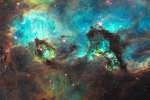 The Seahorse of the Large Magellanic Cloud
22.03.2009
To some it may look to some like a big space monster, but it is more big than monster. To others it may look like a grazing seahorse, but the dark object toward the image right is actually an inanimate pillar of smoky dust about 20 light years long.
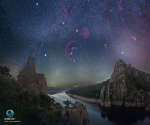 A Dark Winter Sky over MonfragЭe National Park in Spain
13.03.2017
You, too, can see a night sky like this. That is because MonfragЭe National Park in Spain, where this composite image was created, has recently had its night sky officially protected from potential future light pollution.
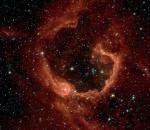 RCW 79: Stars in a Bubble
15.04.2005
A cosmic bubble of gas and dust, RCW 79 has grown to about 70 light-years in diameter, blown by the winds and radiation from hot young stars. Infrared light from the dust embedded in the nebula is tinted red in this gorgeous false-color view from the Spitzer Space Telescope.
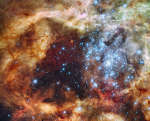 Star Cluster R136 Bursts Out
20.12.2009
In the center of star-forming region 30 Doradus lies a huge cluster of the largest, hottest, most massive stars known. These stars, known collectively as star cluster R136, were captured above in visible light by the newly installed Wide Field Camera peering though the recently refurbished Hubble Space Telescope.
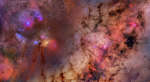 Scorpius Enhanced
15.06.2021
If Scorpius looked this good to the unaided eye, humans might remember it better. Scorpius more typically appears as a few bright stars in a well-known but rarely pointed out zodiacal constellation. To get a spectacular image like this, though, one needs a good camera, a dark sky, and some sophisticated image processing.
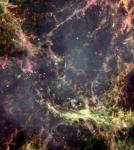 In the Heart of the Crab
5.06.2000
The supernova explosion that formed the Crab Nebula was first seen on the year 1054. Last week, astronomers released a new image of the still-evolving center of the explosion. The above representative-color photograph...
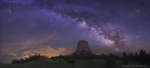 The Milky Way Over Devils Tower
29.07.2009
Was Devil's Tower once an explosive volcano? Famous for its appearance in films such as Close Encounters, the origin of Devil's Tower in Wyoming, USA is still debated, with a leading hypothesis holding that it is a hardened lava plume that probably never reached the surface to become a volcano.
|
January February |
|||||||||||||||||||||||||||||||||||||||||||||||||