
|
You entered: nearest stars
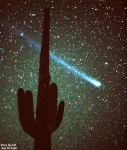 Comet Hyakutake and a Cactus
1.05.1996
Comet Hyakutake is shown photographed the night of March 27 in Arizona, USA, with a cactus in the foreground. Polaris, the north star, is the bright star seen just to the upper right of the comet's head. Today Comet Hyakutake reaches its closest approach to the Sun.
 Messier 24: Sagittarius Star Cloud
27.06.2023
Unlike most entries in Charles Messier's famous catalog of deep sky objects, M24 is not a bright galaxy, star cluster, or nebula. It's a gap in nearby, obscuring interstellar dust clouds that allows a view of the distant stars in the Sagittarius spiral arm of our Milky Way galaxy.
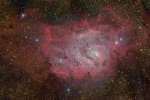 M8: The Lagoon Nebula
17.08.2013
This beautiful cosmic cloud is a popular stop on telescopic tours of the constellation Sagittarius. Eighteenth century cosmic tourist Charles Messier cataloged the bright nebula as M8. Modern day astronomers recognize the Lagoon Nebula as an active stellar nursery about 5,000 light-years distant, in the direction of the center of our Milky Way Galaxy.
 Iridescent by Moonlight
3.12.2021
In this snapshot from November 18, the Full Moon was not far from Earth's shadow. In skies over Sicily the brightest lunar phase was eclipsed by passing clouds though. The full moonlight was dimmed and momentarily diffracted by small but similar sized water droplets near the edges of the high thin clouds.
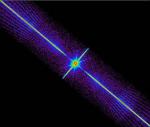 X Ray Rainbows
11.05.2001
A drop of water or prism of glass can spread out visible sunlight into a rainbow of colors. In order of increasing energy, the well known spectrum of colors in a rainbow runs red, orange, yellow, green, blue, indigo, violet.
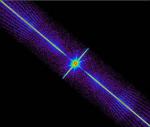 X Ray Rainbows
28.09.2002
A drop of water or prism of glass can spread out visible sunlight into a rainbow of colors. In order of increasing energy, the well known spectrum of colors in a rainbow runs red, orange, yellow, green, blue, indigo, violet.
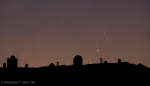 Full Venus and Crescent Moon Rise
13.04.2016
Inner planet Venus and a thin crescent Moon are never found far from the Sun in planet Earth's skies. Taken near dawn on April 6, this timelapse composite shows them both rising just before the Sun. The mountaintop Teide Observatory domes on the fortunate island of Tenerife appear in silhouette against the twilight.
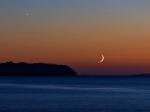 Moon River
9.09.2005
Shortly after sunset on September 6th, sky gazers around the world were treated to a lovely crescent Moon in western skies -- joined by bright planets Venus and Jupiter. In this colorful telephoto view from near Quebec City, Canada the Moon is nestled just above the wide St. Lawrence River.
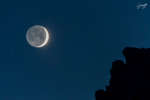 The Bull s Eye and the Young Moon
4.05.2017
Aldebaran, eye of Taurus the Bull, and a young crescent Moon shared an early evening sky last Friday. The lovely celestial pairing could be enjoyed around planet Earth, but from some locations the Moon was even seen to pass in front of Aldebaran, a dramatic lunar occultation of the familiar bright star.
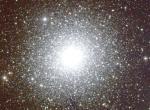 Globular Cluster M2
11.06.2001
Beneath the south pole of our Milky Way Galaxy lies a ball of over 100,000 stars. M2, the second object on Charles Messier's eighteenth century list of bright diffuse sky objects...
|
January February March April May June July August September October |
|||||||||||||||||||||||||||||||||||||||||||||||||