
|
You entered: gas
 IC 2574: Coddington's Nebula
6.02.2025
Grand spiral galaxies often seem to get all the glory, flaunting their young, bright, blue star clusters in beautiful, symmetric spiral arms. But small, irregular galaxies form stars too. In fact dwarf galaxy IC 2574 shows clear evidence of intense star forming activity in its telltale reddish regions of glowing hydrogen gas.
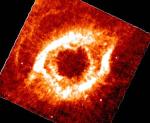 Infrared Helix
1.09.1997
Five hundred light years from Earth, in the constellation Aquarius, a sun-like star is dying. Its last few thousand years have produced the Helix, a well studied and nearby example of a Planetary Nebula - typical of this final phase of stellar evolution.
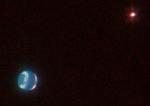 Neptune and Triton from Palomar
20.10.2003
How's the weather on Neptune? Tracking major weather patterns on the Solar System's outermost gas giant can help in the understanding of global weather patterns here on Earth. Each summer for the past five years, Neptune has been imaged and major weather patterns studied.
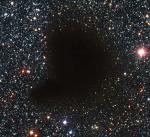 Molecular Cloud Barnard 68
11.05.1999
Where did all the stars go? What used to be considered a hole in the sky is now known to astronomers as a dark molecular cloud. Here, a high concentration of dust and molecular gas absorb practically all the visible light emitted from background stars.
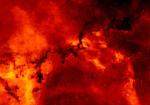 Hydrogen and Dust in the Rosette Nebula
23.12.2005
At the edge of a large molecular cloud in Monoceros, some 3,000 light years away, dark filaments of dust are silhouetted by luminous hydrogen gas. The close up view of the Rosette Nebula...
 Saturn Storm by Ringshine
23.02.2006
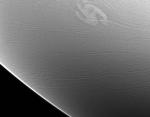
Imaged on the night side of Saturn by the Cassini spacecraft, these swirling storm clouds are illuminated by ringshine - sunlight reflected from the gas giant's magnificent ring system. The storm (top) was actually spotted last month by amateur astronomers as it rotated across Saturn's day side and spans about 3,500 kilometers.
 Central IC 1805
22.09.2006
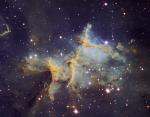
Cosmic clouds seem to form fantastic shapes in the central regions of emission nebula IC 1805. Of course, the clouds are sculpted by stellar winds and radiation from massive hot stars in the nebula's newborn star cluster (aka Melotte 15).
 NGC 6960: The Witch s Broom Nebula
19.08.2008
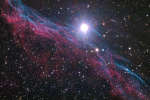
Ten thousand years ago, before the dawn of recorded human history, a new light must suddenly have appeared in the night sky and faded after a few weeks. Today we know this light was an exploding star and record the colorful expanding cloud as the Veil Nebula.
 Polar Ring Galaxy NGC 660
3.12.2009
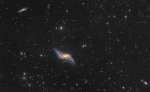
NGC 660 lies near the center of this intriguing field of galaxies swimming within the boundaries of the constellation Pisces. Over 20 million light-years away, its peculiar appearance marks it as a polar ring galaxy.
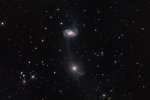 Galaxies on a String
2.07.2010
Galaxies NGC 5216 (top) and NGC 5218 really do look like they are connected by a string. Of course, that string is a cosmic trail of gas, dust, and stars about 22,000 light-years long.
|
January February |
|||||||||||||||||||||||||||||||||||||||||||||||||