
|
You entered: white dwarf
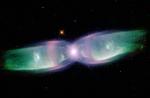 M2 9: Wings of a Butterfly Nebula
12.06.2005
Are stars better appreciated for their art after they die? Actually, stars usually create their most artistic displays as they die. In the case of low-mass stars like our Sun and M2-9 pictured above, the stars transform themselves from normal stars to white dwarfs by casting off their outer gaseous envelopes.
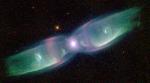 M2 9: Wings of a Butterfly Nebula
21.03.1999
Are stars better appreciated for their art after they die? Actually, stars usually create their most artistic displays as they die. In the case of low-mass stars like our Sun and M2-9 pictured above, the stars transform themselves from normal stars to white dwarfs by casting off their outer gaseous envelopes.
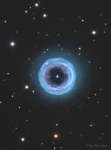 APOD: 2026 March 4 Б Shapley 1: An Annular Planetary Nebula
4.03.2026
WhatБs looking back at you isnБt a cosmic eye, but Shapley 1, a beautifully symmetric planetary nebula. Shapley 1, also known as the Fine Ring Nebula or PLN 329+2.1, bejewels the southern sky constellation of the Carpenter's Square (Norma).
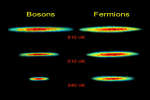 Pauli Exclusion Principle: Why You Don't Implode
28.02.2010
Why doesn't matter just bunch up? The same principle that keeps neutron stars and white dwarf stars from imploding also keeps people from imploding and makes normal matter mostly empty space. The observed reason is known as the Pauli Exclusion Principle.
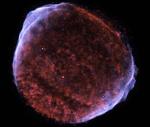 SN 1006: Supernova Remnant in X Rays
26.12.2005
This huge puff ball was once a star. One thousand years ago, in the year 1006, a new star was recorded in the sky that today we know was really an existing star exploding.
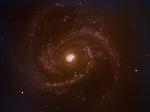 A Nearby Supernova in Spiral Galaxy M100
7.03.2006
One of the nearer supernovas of recent years was discovered last month in the bright nearby galaxy M100. The supernova, dubbed SN 2006X, is still near its maximum brightness and visible with a telescope...
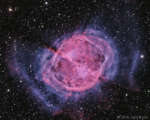 M27: The Dumbbell Nebula
2.11.2016
The first hint of what will become of our Sun was discovered inadvertently in 1764. At that time, Charles Messier was compiling a list of diffuse objects not to be confused with comets.
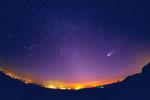 Sirius: The Brightest Star in the Night
11.06.2000
Sirius is the brightest star in the night sky. Sirius is visible on the far left of the above photograph, to the left of the constellation of Orion and Comet Hale-Bopp. Intrinsically, Sirius is over 20 times brighter than our Sun and over twice as massive.
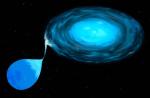 Accretion Disk Binary System
19.12.1999
Our Sun is unusual in that it is alone - most stars occur in multiple or binary systems. In a binary system, the higher mass star will evolve faster and will eventually become a compact object - either a white dwarf star, a neutron star, or black hole.
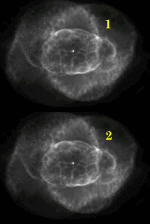 The Incredible Expanding Cats Eye
16.09.1999
Watch closely. As this animation blinks between two Hubble Space Telescope images of NGC 6543 - the first from 1994 and the second from 1997 - the intricate filaments of this nebula are seen to shift. The shift is due to the actual expansion of this gaseous shroud shed by a dying star!
|
January February March April May June July August September |
|||||||||||||||||||||||||||||||||||||||||||||||||