
|
You entered: star cluster
 Pleiades from Planet Earth
1.11.2025
The lovely Pleiades star cluster shines in Earth's night sky, a compact group of stars some 400 light-years distant toward the constellation Taurus and the Orion Arm of our Milky Way galaxy. Recognized since ancient times, the remarkable celestial gathering is visible to the unaided eye.
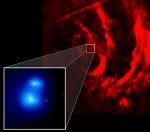 Around The Arches Cluster
14.06.2001
The most compact cluster of stars known in our galaxy, the Arches cluster, boasts 100 or so massive, young stars contained within a diameter of one light-year. Seen toward the constellation Sagittarius, the Arches...
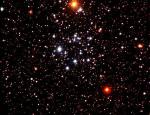 Open Cluster M50
28.01.1997
Many stars form in clusters. Two types of star clusters are visible in our Milky Way Galaxy: open clusters and globular clusters. Open clusters like M50, shown above, typically contain hundreds of stars, many of which are bright, young, and blue.
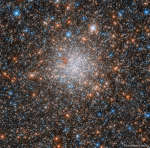 APOD: 2025 December 28 Б NGC 1898: Globular Cluster in the Large Magellanic Cloud
28.12.2025
Jewels don't shine this bright -- only stars do. And almost every spot in this jewel-box of an image from the Hubble Space Telescope is a star. Now, some stars are more red than our Sun, and some more blue -- but all of them are much farther away.
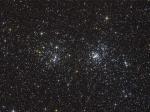 NGC 869 and NGC 884: A Double Open Cluster
11.10.2005
Most star clusters are singularly impressive. Open clusters NGC 869 and NGC 884, however, are doubly impressive. Also known as "h and chi Persei", this unusual double cluster, shown above, is bright enough to be seen from a dark location without even binoculars.
 Pleiades Deep Field
21.09.2011
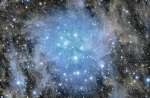
Have you ever seen the Pleiades star cluster? Even if you have, you probably have never seen it like this: all dusty. Perhaps the most famous star cluster on the sky, the bright stars of the Pleiades can be seen without binoculars from even the depths of a light-polluted city.
 Star Forming Region RCW38
7.12.1998
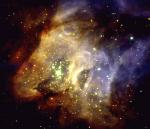
Star cluster RCW38 was hiding. This open cluster of stars is located about 5000 light years away towards the constellation of Vela. Looking there will not normally reveal most of the stars in this cluster, though.
 Messier 5
9.05.2019
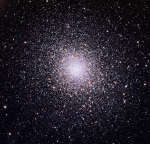
"Beautiful Nebula discovered between the Balance [Libra] & the Serpent [Serpens] ..." begins the description of the 5th entry in 18th century astronomer Charles Messier's famous catalog of nebulae and star clusters. Though it appeared...
 Messier 5
3.08.2012
"Beautiful Nebula discovered between the Balance [Libra] & the Serpent [Serpens] ..." begins the description of the 5th entry in 18th century astronomer Charles Messier's famous catalog of nebulae and star clusters. Though it appeared...
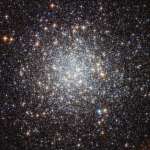 Messier 9 Close Up
23.03.2012
Renown 18th century astronomer Charles Messier described this 9th entry in his famous astronomical catalog as "Nebula, without star, in the right leg of Ophiuchus ...". But Messier 9 (M9) does have stars, known to modern astronomers as a globular cluster of over 300,000 stars within a diameter of about 90 light-years.
|
January February March April May June July August September |
|||||||||||||||||||||||||||||||||||||||||||||||||