
|
You entered: solar wind
 MAVEN s Ultraviolet Mars
27.06.2023
These two global views of Mars were captured at ultraviolet wavelengths, beyond the spectrum visible to human eyes. Recorded by the MAVEN spacecraft's Imaging Ultraviolet Spectrograph instrument in July 2022 (left) and January 2023, three otherwise invisible ultraviolet bands are mapped into red, green, and blue colors.
 The Further Tail of Comet Leonard
30.12.2021
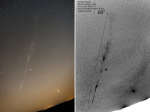
Comet Leonard, brightest comet of 2021, is at the lower left of these two panels captured on December 29 in dark Atacama desert skies. Heading for its perihelion on January 3 Comet Leonard's visible tail has grown.
 Three Tails of Comet NEOWISE
8.03.2021
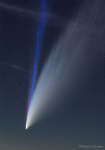
What created the unusual red tail in Comet NEOWISE? Sodium. A spectacular sight back in the summer of 2020, Comet NEOWISE, at times, displayed something more than just a surprisingly striated white dust tail and a pleasingly patchy blue ion tail.
 Comet Tails and Star Trails
21.07.2015
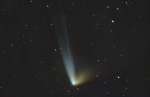
After grazing the western horizon on northern summer evenings Comet PanSTARRS (also known as C/2014 Q1) climbed higher in southern winter skies. A visitor to the inner Solar System discovered in August 2014 by the prolific panSTARRS survey, the comet was captured here on July 17.
 Coronal Holes on the Sun
18.03.2003
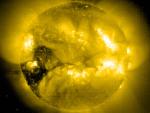
The ominous, dark shapes haunting the left side of the Sun are coronal holes -- low density regions extending above the surface where the solar magnetic field opens freely into interplanetary space. Studied extensively from...
 Comet Hale Bopp Over Val Parola Pass
9.04.2017
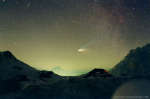
Comet Hale-Bopp, the Great Comet of 1997, became much brighter than any surrounding stars. It was seen even over bright city lights. Away from city lights, however, it put on quite a spectacular show. Here Comet Hale-Bopp was photographed above Val Parola Pass in the Dolomite mountains surrounding Cortina d'Ampezzo, Italy.
 The Ion Tail of Comet Hyakutake
19.03.1996
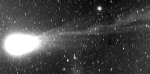
This picture of Comet Hyakutake was taken on March 14, 1996. Structure in the ion tale of Comet Hyakutake is now clearly visible. An ion tale forms as a comet nears the Sun. Sunlight causes gas and dust to boil off the comet's solid nucleus.
 Shadow Of A Comet
2.07.1999
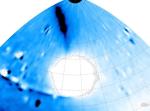
Hale-Bopp, the Great Comet of 1997, may have been the most viewed comet in history - visible even from bright metropolitan skies. Astronomers are now reporting that this magnificent comet also cast a shadow against the glare of the solar system's ultraviolet haze.
 Cosmic Rays at Voyager 1
8.09.2012
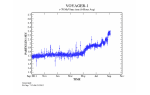
Launched on a grand tour of the outer planets in 1977, by good fortune the twin Voyager spacecraft were also headed in the general direction of the Sun's motion relative to nearby stars. Thirty five years later, Voyager 1 appears to be nearing the boundary of the Sun's heliosphere and interstellar space.
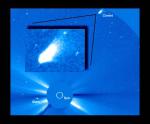 Discovery Image: Comet SOHO (1998 J1)
20.05.1998
Staring at the Sun from a vantage point in space (Kids, don't try this at home!), the Solar and Heliospheric Observatory (SOHO) has enabled the discovery of much about our closest star. It has also been used to discover about 50 comets.
|
January February March April May June July August September |
|||||||||||||||||||||||||||||||||||||||||||||||||